
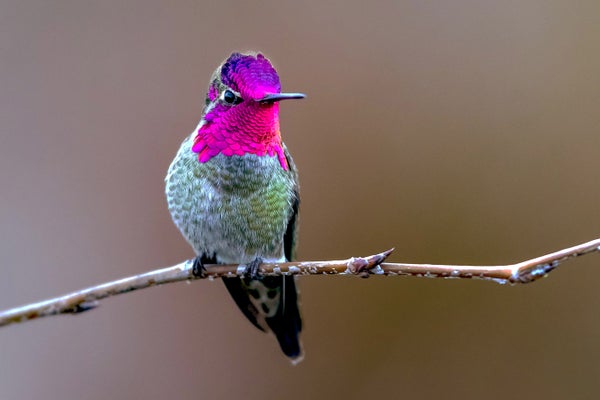
What looks like an elaborate sequined mask on this male hummingbird could disappear the second he tilts his head. The throat and face feathers are iridescent—depending on the viewing angle, the plumage might flash brilliant or mundane hues. In this species, called Anna’s hummingbird (Calypte anna), only males have an iridescent face and neck. The male Anna’s hummingbird courts mates by sitting absolutely still and singing his heart out to a potential companion. By freezing in place, he guarantees she sees his magenta face coloring.
Researchers are still investigating the purpose of the kaleidoscopic coloring. Iridescence appears in birds, beetles, spiders, and more. Some biologists think that glittering might bolster an animal’s attempt at getting noticed by potential mates, for example. And some organisms can control the precise angles at which they display their iridescent features, indicating that they use their colors to communicate. But such communication strategies have to be reliable and consistent, a research team at the University of Melbourne in Australia pointed out in a recent paper in Trends in Ecology & Evolution. A color that shifts with the tiniest movement of its viewer or owner seems like the opposite of “dependable.”
The group concluded that disco ball-like body parts probably come with other physical or behavioral features that ensure the message gets across. Such iridescence-based communications tactics might be useful for humans, too, said study co-author Devi Stuart-Fox in a University of Melbourne press release. “Understanding how animals reliably use and produce these shifting signals can help the development of bio-inspired iridescent materials designed for human observers,” she noted.
On supporting science journalism
If you're enjoying this article, consider supporting our award-winning journalism by subscribing. By purchasing a subscription you are helping to ensure the future of impactful stories about the discoveries and ideas shaping our world today.