
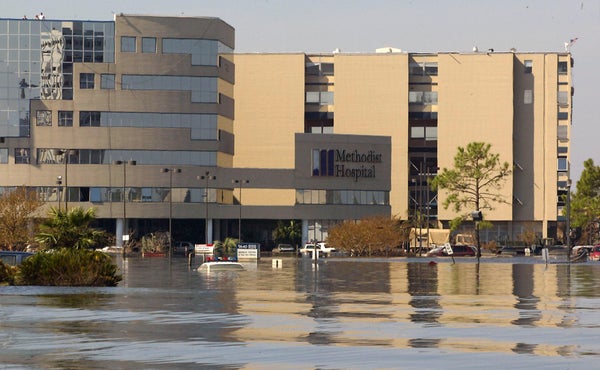
Hundreds of hospitals along U.S. coastlines are in danger of flooding when hurricanes strike, new research warns. And as sea levels continue rising, so will the flood risks.
The findings were published Thursday in the journal GeoHealth by a team of researchers from Harvard University’s T.H. Chan School of Public Health.
The study examined 682 acute care hospitals in 78 metropolitan areas along the East Coast and Gulf Coast, all situated within 10 miles of the shore. Using a storm-surge model developed by the National Weather Service, the researchers investigated which sites were at risk of flooding in the event of a hurricane making landfall as a Category 1, 2, 3 or 4.
On supporting science journalism
If you're enjoying this article, consider supporting our award-winning journalism by subscribing. By purchasing a subscription you are helping to ensure the future of impactful stories about the discoveries and ideas shaping our world today.
They found that 147 hospitals, containing more than 40,000 beds, likely would flood in the event of a Category 1 hurricane. A Category 4 storm would put 306 hospitals at risk.
In many cases, multiple hospitals in a single metropolitan area are likely to flood at once—even in the event of a low-category hurricane. In nearly a third of all the cities investigated, a Category 2 storm likely would flood more than half the hospitals in the entire metropolitan area.
The study warns that Florida is one of the most concerning areas. It’s heavily populated and contains some of the highest proportions of hospitals and hospital beds at risk—and it also has some of the highest likelihoods of hurricane landfalls.
While hurricane landfalls are less likely in the Northeast, the region’s populous cities mean that large numbers of people would suffer if its hospitals were to flood.
Next, the researchers examined the ways future sea-level rise might affect hurricane flood risks. Higher ocean levels can worsen the impact of storm surge.
If sea levels rose by around 2.7 feet—a likely possibility by the end of the century in the event of severe future warming—the risk of flooding would increase for hurricanes of all categories. Cities including Baton Rouge, La.; Virginia Beach, Va.; Corpus Christi, Texas; Philadelphia; and Boston all saw more than 90 percent increases in the number of beds at risk from a Category 2 storm.
“We now have a better sense of which hospitals are likely to flood from a hurricane today and those that need to prepare for greater risks in the future,” said senior study author Aaron Bernstein, interim director of the Harvard Chan Center for Climate, Health and the Global Environment, in a statement.
The researchers went a step further. They also investigated hospitals with nearby roads likely to flood during hurricanes—potentially cutting off access to people in need of health care. They found seven metropolitan statistical areas where at least half the roads within a mile of a hospital would be at risk of flooding during a Category 2 storm.
In general, areas with flooded roads likely would have flooded hospitals, too. But the study identified a few metropolitan areas where dry hospitals were likely to be surrounded by flooded roads, including Boston and New York.
“With prospects of more intense hurricanes making landfall atop higher seas owing to climate change, greater resilience to hurricanes will be necessary to ensure that healthcare remains viable when it is needed most,” the researchers write.
Reprinted from E&E News with permission from POLITICO, LLC. Copyright 2022. E&E News provides essential news for energy and environment professionals.