
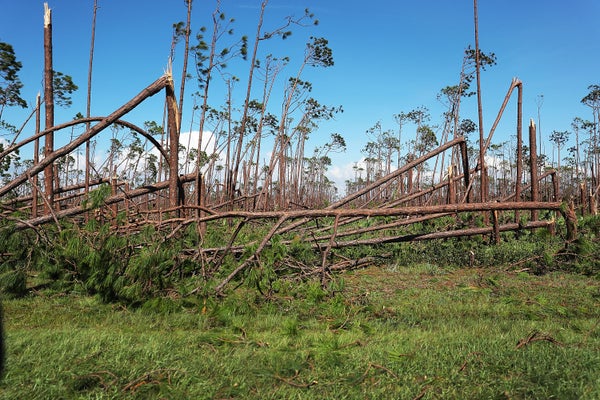
The surging seas and vicious winds that Hurricane Michael unleashed on the Florida Panhandle last October have long since died down. Yet the scars left by the strongest storm ever to strike the region have ramped up the risk of another type of natural disaster for years to come: across millions of acres of forest stretching into southern Georgia, the carcasses of pine trees—snapped like matchsticks by the storm’s winds—pose a major wildfire threat.
“I’ve never seen anything like this,” says Kevin Hiers, a fire scientist at Tall Timbers Research Station in Tallahassee, after surveying the vast swaths of downed timber.
As Florida enters this year’s dry season, one blaze has already broken out in Panama City, which is in the northwestern part of the state and still recovering from the storm. A minor fire that started in yard debris got into the fallen timber and grew overnight into a 600-acre-plus blaze that forced about two dozen homes to evacuate. Officials are working to reduce the threat of further fires, but are hamstrung by the huge numbers of downed trees and limited funding. And the problem is unfolding against a backdrop of rising temperatures, which are changing the conditions that affect wildfires in the region and posing challenges to existing disaster mitigation strategies. “We have to take this climate crisis seriously, and do more on prevention before disaster and recovery after,” Florida Agriculture Commissioner Nikki Fried said in a statement.
On supporting science journalism
If you're enjoying this article, consider supporting our award-winning journalism by subscribing. By purchasing a subscription you are helping to ensure the future of impactful stories about the discoveries and ideas shaping our world today.
“I’d Be Really Worried”
The core of the tree damage covers 350,000 acres of Florida forest that were completely destroyed, leaving a tinderbox of 100 tons of dead wood an acre. That is more than 10 times the amount of fallen leaves and limbs that accumulate in a normal year without a storm, Hiers says. An additional 4.6 million acres sustained lesser, but still worrisome, damage. With the rainy season ending, Florida State Forester Jim Karels warned in March that the region could see intense blazes “similar to the West, if we don’t get rid of the debris.”
But the extent of the damage makes that difficult to do quickly. Even heavy bulldozers struggle to get through the thickets of snapped trees to clear debris. Forest managers have started controlled burns, but covering the total acreage affected by Michael could take years. So far, the federal government has not provided extra money to supplement these efforts. At the current pace, Hiers estimates a full cleanup could take 10 years or more. “If I was a fire manager or land manager I’d be really worried,” says Mike Flannigan, a wildfire researcher at the University of Alberta. “If you do get a fire, it’s going to be extremely hard to put it out, because there’s so much fuel there.”
Crews were able to contain the fire near Panama City, and some rain later that week helped. But soon drier summer weather will arrive—along with more lightning, which can ignite new blazes.
Harbinger of Things to Come?
Southeastern wildfires present different challenges from the conflagrations that have long routinely plagued the West. Most forested land in the Southeast is in smaller, privately owned parcels, meaning there are more people and structures in harm’s way compared with the huge tracts of uninhabitated federal land in the West. For decades the Southeast has mitigated the threat by maintaining aggressive controlled burn programs, even when such measures fell out of favor in other regions. These programs have reduced the risk of large, intense fires, because normal debris on the forest floor is burned away instead of building up year after year. Controlled burns—along with clearing debris and warning the public of fire dangers—helped prevent major wildfire damage after Hurricane Hugo wiped out forested areas in South Carolina in 1989, says Carly Phillips, an expert on climate and energy with the Union of Concerned Scientists.
But that was 1989, she says—“now there are all these other kinds of compounding factors from climate change.” It is still uncertain how some of those factors (such as rain patterns over Florida) might change, but it is clear from climate models that temperatures have and will continue to rise in all seasons across the Southeast. That means future droughts are very likely to be longer and more intense than today’s; this increases wildfire risks, according to the Fourth National Climate Assessment published in 2018, to which Hiers contributed. “As the atmosphere warms, the ability to suck moisture out of dead fuel increases almost exponentially,” Flannigan says. “The drier the fuels are, the easier it is for fires to start, to spread, and to burn more intensely.”
Pines and vegetation in the Southeast are naturally resistant to low-intensity fires, but trees cannot survive burns that go all the way up to their crowns. High-intensity fires “just race across the landscape until the weather changes or the fuel changes,” Flannigan says, and management options are limited at that scale.
As for the ways climate change might alter the likelihood and intensity of hurricanes, scientists are still working that out. Yet Hiers worries that the intersection of hurricane damage and wildfire threats is a harbinger of things to come—and that Florida will not be ready. “We know that the climate is changing already,” he says. “But we don’t have good plans for how to really combat the inevitable,” which is that another powerful storm like Hurricane Michael will someday hit the Southeast and leave huge fire threats behind.