
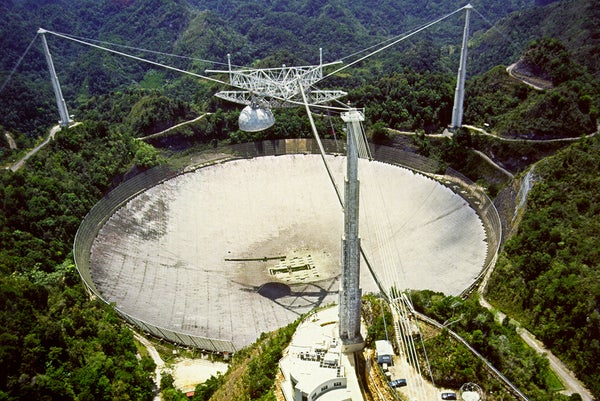

The second-largest radio telescope in the world has suspended operations as powerful Hurricane Irma churns ever closer.
The Arecibo Observatory in Puerto Rico, which features a 1,000-foot-wide (305 meters) radio dish, is closed for safety reasons until further notice, telescope representatives said via Twitter on Tuesday (Sept. 5).
“We will return to our regular operations when weather conditions permit,” the officials added (in Spanish) in another tweet from the @NAICobservatory account. [Hurricane Irma in Photos: Monster Storm Seen from Space]
On supporting science journalism
If you're enjoying this article, consider supporting our award-winning journalism by subscribing. By purchasing a subscription you are helping to ensure the future of impactful stories about the discoveries and ideas shaping our world today.
Arecibo representatives also posted several photos on Twitter of personnel clambering about the huge radio dish, installing or securing equipment. “Taking preventive measures for #HurricaneIrma,” they wrote about the photos.
As of Tuesday evening, Irma had ramped up to a Category 5 hurricane — the most powerful type — with maximum sustained winds of around 185 mph (300 km/h). The storm, which the U.S. National Weather Service (NWS) has described as “potentially catastrophic,” is bearing down on Puerto Rico and the U.S. Virgin Islands.
“Irma is forecast to move just northeast of the local islands Wednesday afternoon through early Thursday morning,” NWS officials wrote in a statement. “Irma is expected cause dangerous winds, storm surge, rip currents and rainfall impacts across the local islands. Hurricane-force wind likely across the Northern U.S. Virgin Islands, Culebra, Vieques and northeast Puerto Rico, with strong tropical-force winds elsewhere.”
Irma may later barrel into southern Florida as well, forecasters have said.
The Arecibo Observatory began observing the heavens in 1963. Ever since its debut, astronomers have used the big dish for a variety of purposes, from capturing radar images of asteroids to listening for possible signals from intelligent aliens. Arecibo also famously served as the backdrop for a dramatic scene in the 1995 James Bond film “GoldenEye.”
For more than half a century, Arecibo was the world's largest single-aperture telescope. But it lost that distinction last year, when China's Five-hundred-meter Aperture Spherical Telescope (FAST) came online. (Russia's RATAN-600 radio telescope is wider than either Arecibo or FAST; however, RATAN-600 is not a single, completely filled dish but rather a ring surrounding mostly empty space.)
Irma is following closely on the heels of Hurricane Harvey, which slammed into southeast Texas late last month and lingered, devastating the region with record-breaking rain and flooding.
Follow Mike Wall on Twitter @michaeldwall and Google+. Follow us @Spacedotcom, Facebook or Google+. Originally published on Space.com.
Editor's Recommendations
Copyright 2017 SPACE.com, a Purch company. All rights reserved. This material may not be published, broadcast, rewritten or redistributed.