
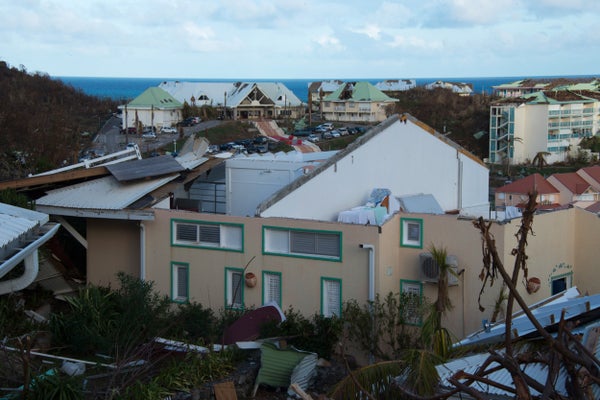
As Hurricane Maria exited the northwestern coast of Puerto Rico en route to other islands in the Caribbean, the storm was officially classified “category 4”. When Maria steamrolled the island of Dominica earlier this week, it was a “category 5”. These designations refer to the Saffir–Simpson hurricane wind scale, which meteorologists have been using since 1973 as a shorthand to describe a storm’s intensity. Such generalizations are convenient, but a closer look at Saffir–Simpson reveals the U.S. National Hurricane Center (NHC) packs a lot of information into each category.
Maria’s eye assaulted the town of Yabucoa, Puerto Rico, on Wednesday with maximum sustained winds of nearly 250 kilometers per hour (155 miles per hour)—the high end of category 4—making it the strongest storm to hit the island since the San Ciprian Hurricane of 1932. Category 4 hurricanes—which feature sustained winds between 209 and 251 kph (130 and 156 mph)—typically snap or uproot trees and power poles, destroy older mobile homes and can leave areas “uninhabitable for weeks or months,” according to the NHC.
This year’s hurricane season is the most active since 2010, with four major storms so far, says Gerry Bell, a hurricane climate specialist and research meteorologist at the National Oceanic and Atmospheric Administration (NOAA) Climate Prediction Center. “Typically, when you get very strong storms like Harvey, Maria and Irma, they form in the tropical Atlantic, the Gulf of Mexico or the Caribbean Sea in an area of weak wind shear”— conditions which crank out storms that are not fast-moving and stay together for longer periods of time—Bell explains. “A very strong ridge of high pressure in the upper atmosphere has made for very weak wind shear from just east of the Caribbean islands all the way to the U.S. As a result, we’ve had these category 4 and 5 hurricanes forming in that region.”
On supporting science journalism
If you're enjoying this article, consider supporting our award-winning journalism by subscribing. By purchasing a subscription you are helping to ensure the future of impactful stories about the discoveries and ideas shaping our world today.
These numbers do not tell the whole story, of course. A category 1 hurricane such as Matthew in 2016 might bring sustained winds no greater than 153 kph (95 mph) but still cause dozens of deaths and billions of dollars in damage. “The most important thing to realize about the current hurricane season is that we’re still right in the peak of a very active season,” Bell says. “There’s a long way to go, and coastal residents need to remain vigilant and prepared for the next storm.”