
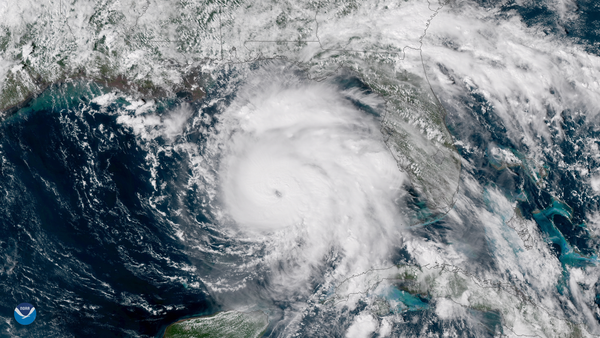
Hurricane Michael is expected to make landfall later today in one of Florida’s least populated corners, a rural expanse of the Panhandle known more for pine forests and oyster beds than oceanfront towers.
But given the storm’s immense size and growing strength, experts say it will still likely have a multibillion-dollar impact on the state. Early projections have put private property damages at between $13 billion and $19 billion, depending on whether the storm makes landfall as a Category 3 or 4 hurricane.
An early analysis from the real estate analytics firm CoreLogic Inc. found that just over 52,000 homes are at risk of storm surge damage if Michael arrives as a Category 3 storm on the northern Gulf Coast. Under a Category 4 scenario, the number of at-risk homes rises to 84,000, according to the firm.
On supporting science journalism
If you're enjoying this article, consider supporting our award-winning journalism by subscribing. By purchasing a subscription you are helping to ensure the future of impactful stories about the discoveries and ideas shaping our world today.
As of yesterday evening, the National Weather Service had issued a hurricane warning along roughly 340 miles of the coast, from the Alabama-Florida border to the Suwannee River.
A westward drift—toward the Crestview-Fort Walton Beach-Destin metropolitan statistical area—would be considerably more destructive than a landfall between Panama City and Port St. Joe, where both the number and value of at-risk homes is lower, based on reconstruction cost value estimates provided by CoreLogic.
If Michael’s storm surge is centered even more to the east, over Apalachicola Bay, it could hit several barrier islands—including the resort community of St. George Island—before plowing northward through the Apalachicola National Forest toward Tallahassee. There, between 7,000 and 12,000 homes would be at risk from a Category 3 or 4 storm.
Reached at his Gainesville, Fla., home yesterday, Craig Fugate, the former Federal Emergency Management Agency administrator and creator of the “Waffle House Index” of storm severity, said he was particularly concerned about a string of three Panhandle counties—Gulf, Franklin and Wakulla—that appeared to be on the windward side of Michael.
“Those are three little counties that are going to take a big hit. The whole area is very low-lying and has very high storm surge,” said Fugate, who is currently chief emergency management officer for the disaster planing and climate resilience firm One Concern.
“And it’s not just the coastal zone,” he added. “The entire corridor from Tallahassee to Thomasville [in Georgia] has been growing, so folks inland can expect to see damage too.”
If Michael brings Category 3 winds, defined as between 111 and 129 mph, into the Panhandle, Fugate said the potential for tree damage and power outages associated with downed trees is particularly high as far inland as south Georgia.
Gordon Paulus, a spokesman for Gulf Power, the investor-owned utility serving much of the Panhandle, said the company has its storm plans in place and is ready for any scenario that comes with Michael.
In addition to deploying 1,200 Gulf Power employees to the region, the utility said it has secured assistance from 1,000 additional workers to help with power restoration.
Meanwhile, Florida emergency management officials were pressing local communities to ramp up evacuations and other preparations in advance of Michael’s arrival.
As of yesterday, mandatory evacuation orders were in place for the coastal zone and low-lying areas of nine counties: Bay, Dixie, Franklin, Gulf, Jackson, Levy, Okaloosa, Wakulla and Walton.
In a Monday email to county and local officials, Florida Division of Emergency Management Wes Maul urged local officials to step up their preparation efforts. He noted the state had not received the volume of “mission requests” that would normally be expected for a hurricane the size of Michael.
And in a meeting yesterday with staff in Tallahassee, Maul expressed concern that local officials were acting too slowly to set up emergency shelters or to file requests for critical commodities following Gov. Rick Scott’s (R) state-of-emergency declaration Sunday.
Additional federal resources were expected to begin flowing into the Panhandle region yesterday after President Trump issued a pre-disaster declaration order for 35 counties.
Reprinted from Climatewire with permission from E&E News. E&E provides daily coverage of essential energy and environmental news at www.eenews.net.