
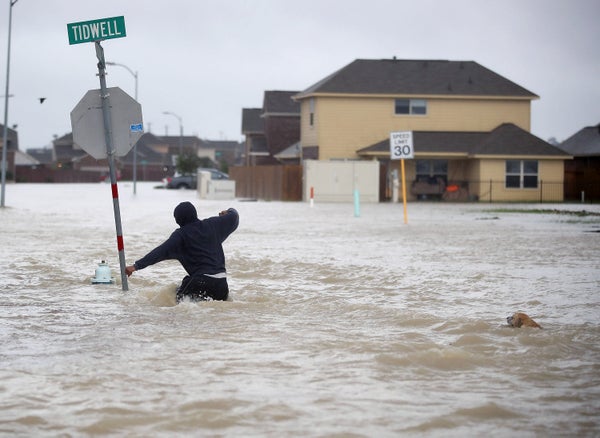
Sluggish hurricanes have become increasingly common over the past 70 years, according to a new study. Storms that linger over a given area for longer periods, such as Hurricane Harvey, which stalled over eastern Texas for almost a week in August 2017, bring more rain and have greater potential to cause damage than ones that pass quickly. Scientists aren't sure why this is happening, but if the trend continues, future hurricanes could be even more disastrous.
The study, published on 6 June in Nature, is the first to analyse hurricane speeds globally. It finds that the speed at which tropical cyclones moved across the planet slowed by about 10% between 1949 and 2016. The storms travelled at more than 19 kilometres an hour on average in 1949, compared with an average speed of about 17 kilometres an hour in 2016. The effect was significant over land, with cyclones affecting regions along the western North Pacific slowing by 30% and by about 20% over Australia and landmasses in or near the North Atlantic.
“That’s a big signal,” says study author James Kossin, a climate scientist at the US National Oceanic and Atmospheric Administration’s (NOAA) Cooperative Institute for Meteorological Satellite Studies in Madison, Wisconsin. After studies suggested that atmospheric circulation patterns in the tropics might be slowing as a result of global warming, Kossin set out to see whether hurricanes, which are carried along by these wind currents, also put on the brakes. “I'm not sure that I was quite prepared for the amount of slowing that I did find,” he says.
On supporting science journalism
If you're enjoying this article, consider supporting our award-winning journalism by subscribing. By purchasing a subscription you are helping to ensure the future of impactful stories about the discoveries and ideas shaping our world today.
Because storms are growing more sluggish, there’s more time for rain to fall. Kossin notes that a 10% reduction in hurricane speed corresponds to a 10% increase in the amount of rainfall over a given area. The effect could be magnified by a warming climate, because recent global simulations estimate up to a 10% increase in rain rate per degree Celsius of warming.
Slower, more rain-heavy hurricanes would lead to more flooding events, says David Nolan, a hurricane scientist at the University of Miami in Florida. And sustained winds could also pose a risk: buildings that are battered by strong winds for longer periods are more likely to be damaged, he says.
An open question
These sluggish tropical cyclones are “an interesting finding that could have important implications”, says Tom Knutson, a research meteorologist at NOAA's Geophysical Fluid Dynamics Laboratory in Princeton, New Jersey. But researchers aren't sure what has caused the slowdown. Knutson says it's an open question whether human-driven climate change or natural variability is to blame. It’s also not clear if the slowdown in atmospheric tropical circulation patterns influences the speed at which hurricanes move across the globe, he adds. Knutson notes that his team's climate models, which simulate future Atlantic hurricanes, don’t project that storms will slow down, even if researchers tweak the model to slow those circulation patterns.
It’s possible that the observed decrease in hurricane speed is a result of unreliable data, says Kevin Trenberth, a climate scientist at the US National Center for Atmospheric Research in Boulder, Colorado. He notes that satellites have tracked storms across the globe only since the late 1960s, so data acquired before then might not be reliable and should be discounted.
But Kossin disagrees, saying that data on the speed of these storms are less sensitive to technological advances than data about their frequency and intensity. “The differences in the way we tracked [storms] 50 years ago are not as great as the differences in the way we estimated their intensities.” Moreover, Kossin says, a study this year found that several past hurricanes would have been slower had they happened in a warmer climate. “That gives us more confidence that the slowing is there and is related to warming.”
This article is reproduced with permission and was first published on June 6, 2018.