
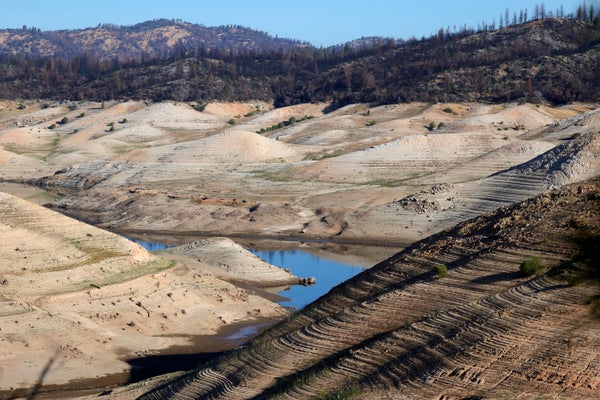
A drought worsened by climate change has caused hydropower supplies in California to reach their second-lowest level since 2001, leading electricity prices in the state to soar 150% in three months' time.
Yet some of the biggest beneficiaries of the price surge, according to a credit ratings agency report yesterday, are fossil fuel-fired power producers whose emissions only exacerbate global warming.
California's predicament — in which emissions-free hydropower is replaced by planet-warming power from natural gas plants — underscores the need to rapidly decarbonize the electric grid, according to sustainability experts.
On supporting science journalism
If you're enjoying this article, consider supporting our award-winning journalism by subscribing. By purchasing a subscription you are helping to ensure the future of impactful stories about the discoveries and ideas shaping our world today.
"That way, if we do have challenges with generation from one renewables sector, we'll be able to make up for it with renewables from another," said Kristen Averyt, a research professor at the University of Nevada, Las Vegas, who's focused on climate resilience efforts.
In May, monthly power prices in California were under $30 per megawatt-hour, Moody's Investors Service said in the report. By July, they'd topped $80 per MWh — their highest level since at least 2016.
"High power prices are credit positive for non-hydro-dependent power generators that sell into the California power market," the report said.
Moody's highlighted three power producers set to profit from the state's drought-driven decline in hydropower: Calpine Corp., Vistra Corp. and Generation Bridge LLC.
Houston-based Calpine has 35 power plants in California with a generation capacity of 6,425 megawatts, according to company data. Of that generating capacity, 88% is powered by fossil fuels.
Vistra, another Texas company, is even more dependent on fossil fuels. The Carbon Tracker Initiative, a clean energy think tank, estimates that 90% of its fleetwide power capacity is from natural gas and coal plants.
Generation Bridge, meanwhile, is a holding company composed entirely of gas- and oil-fired peaking plants, according to a Moody's report from earlier this month.
In California, Generation Bridge has two gas-fired peakers that can produce 773 MW when power demand in the state is at its highest. The holding company is owned by a fund of ArcLight Capital Partners LLC, a Boston-based private equity firm.
Sourcing power from those companies may help California keep on the lights in the short term, but it's harmful to the nation's long-term climate goals, Averyt said.
"The last thing we want to be doing right now is increase our emissions," she said.
Calpine, Vistra and ArcLight did not respond to requests for comment.
Hydropower historically has provided about 15% of California's electricity. But a decadeslong drought has caused production from the sector to plummet.
Earlier this month, low water levels at the Oroville Dam forced the state to shut down the Edward Hyatt Power Plant, one of its largest hydro facilities (Greenwire, Aug. 6).
Reprinted from E&E News with permission from POLITICO, LLC. Copyright 2021. E&E News provides essential news for energy and environment professionals.