
On supporting science journalism
If you're enjoying this article, consider supporting our award-winning journalism by subscribing. By purchasing a subscription you are helping to ensure the future of impactful stories about the discoveries and ideas shaping our world today.
Earth has its fair share of orbiting paparazzi—numerous satellites continually collect information about the planet. On October 17 NASA released the data from one of those spacecraft in the form of an updated topographic world map.
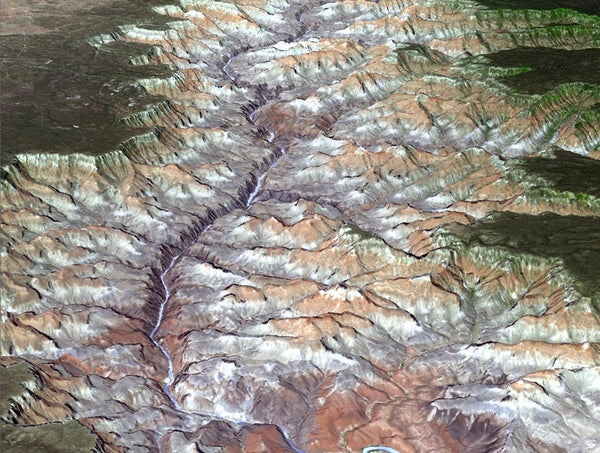
The new images come from a collaboration between NASA and the Japanese Advanced Spaceborne Thermal Emission and Reflection Radiometer (ASTER) device on board NASA's Terra spacecraft. The instrument collects data by scanning Earth with an array of telescopes that read 15 different bands of the electromagnetic spectrum. The data can then be reassembled into highly detailed images, like this one of the Grand Canyon. Because the instrument takes two readings slightly offset from one another, the images appear to be three-dimensional—a process that resembles how the brain assembles one stereoscopic image from two eyes.
This new data set improves on the original 2009 data in two ways. By adding 260,000 new images, the researchers have doubled the map's resolution. Now, the map is able to identify lakes as small as one kilometer in diameter, and includes readings every 30 meters. The group also filtered out errors caused by clouds. When the satellite collects data, it can read clouds as land or water, and distort height inputs.
Uses for topographical data include everything from hiking navigation to determining cell phone service, says Mike Abrams, the team leader on the NASA side of the project, who adds, "This is probably one of the really basic data sets required to describe our world."