
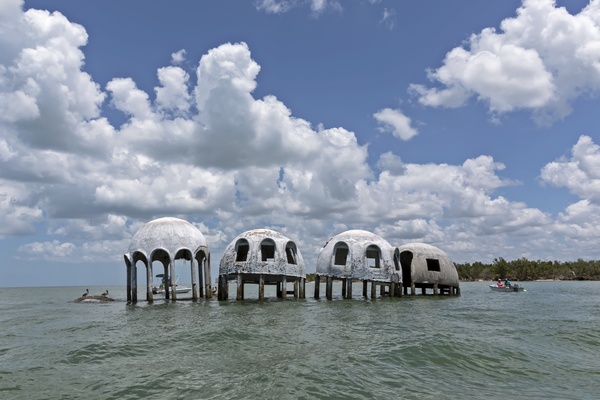
It was an architectural icon, a forebear to hurricane readiness and a cautionary tale about building too close to the shore.
The Cape Romano dome home, completed in 1982 on a sand spit of Marco Island, Fla., has succumbed to the sea.
Hurricane Ian knocked down what remained of the 40-year-old string of six concrete-reinforced geodesic domes that were adjoining rooms in the 2,400-square-foot modular house. Its spherical walls were built to deflect 150-mph winds that would level most conventionally designed homes.
On supporting science journalism
If you're enjoying this article, consider supporting our award-winning journalism by subscribing. By purchasing a subscription you are helping to ensure the future of impactful stories about the discoveries and ideas shaping our world today.
The dome home was ahead of its time and a harbinger of storm-resilient living until it was abandoned in 2007 after the beach it was built upon eroded away, leaving the domes on pilings about 100 yards offshore.
Two of the original domes collapsed after Hurricane Irma. The final four remained a spooky relic until last week. Then they went underwater.
Alex Demooy, owner of the Naples-based charter tour company Breakwater Adventures, was among the first to photograph the spot where the domes once stood.
“Everyone’s pretty sad. It had been sitting out there for a long time,” he said Monday in a telephone interview from Naples.
Demooy wasn’t sentimental about the structure, which to many had become an unsightly, poop-stained pelican roost. But every client marveled at it, he said, and no one who saw it forgot.
So he posted a picture to Instagram. It drew more than 750 “likes” in two days. Another Instagram user’s photo, captioned “R.I.P. TO THE DOMES,” drew nearly 2,200 likes by Monday afternoon.
“Knew it would happen someday. So sad,” one viewer of Demooy’s post said.
“I was wondering if they’d make it,” another said.
“So heartbreaking,” wrote a third.
Though it will be missed by some, experts say the Romano dome home offered a cautionary tale about the perils of building too close to the shoreline as the planet warms. Not only is climate change worsening storms like Hurricane Ian, it’s also lifting sea levels and increasing the risk of coastal flooding.
Southwest Florida’s coastline has seen between 6 and 8 inches of sea-level rise since 1990, according to data records. A recently released report from NOAA projects the region will see an additional 1.5 feet of additional rise by 2050 based on the current rate of greenhouse gas emissions.
“This is a clear sign of things to come, particularly in low-lying areas that are not protected,” Jayantha Obeysekera, a research professor and director of the Sea Level Solutions Center at Florida International University, toldE&E News in 2019 about the Romano dome home.
“It demonstrates the power of the ocean, and I think it’s a very telling example of how climate change and sea-level rise will affect us in the future,” Obeysekera added (Climatewire, Nov. 18, 2019).
Demooy said he wasn’t surprised to see the dome home go underwater after a storm like Ian.
“We were pretty sure when we came around the corner that it would be gone,” he said of his Friday discovery. “It was built to withstand hurricanes, but it wasn’t built to withstand this.”
Reprinted from E&E News with permission from POLITICO, LLC. Copyright 2022. E&E News provides essential news for energy and environment professionals.