
Deep below the bright, smooth surface of Antarctica's ice shelves lies a dark landscape unlike any other on earth, where inverted canyons and terraces reach far up into the ice. Fed by glaciers on land, these giant ice ledges float on the Southern Ocean's frigid waters. This year a fleet of seven underwater robots developed by the University of Washington headed into this world on a risky mission. Their goal: to help forecast sea-level rises by observing the melting process in this hidden topsy-turvy landscape, where layers of warm and cool water mix.
“We have known for about 40 years that ice shelves are intrinsically unstable,” says Knut Christianson, a glaciologist on the mission and a leader of U.W.'s Future of Ice initiative. “But we do not really understand the variability of these systems, let alone how they react to a significant external [force] such as warming sea temperatures.”
Previous efforts to explore the undersides of ice shelves have involved scientists drilling through them or sending robotic submarines on short trips below them. But these efforts have been restricted to small areas and brief periods—snapshots that do not necessarily reflect the full behavior of the ice-and-water system, Christianson says.
On supporting science journalism
If you're enjoying this article, consider supporting our award-winning journalism by subscribing. By purchasing a subscription you are helping to ensure the future of impactful stories about the discoveries and ideas shaping our world today.
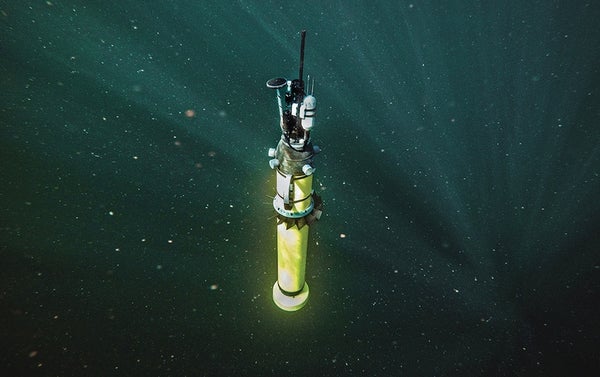
The new team of robotic explorers consists of three self-propelled drones, called Seagliders, accompanied by four drifting floats. All the vehicles contain instruments that measure temperature, pressure, turbulence and dissolved oxygen. Each of the $100,000 Seagliders will follow a several-week route under, around and back from the ice shelves. The drones swim by adjusting their buoyancy and wings to glide slowly in a programmed direction. The $30,000 floats, in contrast, are at the mercy of ocean currents; they can regulate their movement only to rise or sink.
If a drone or float rises into a crevasse or gets trapped under one of the terraces, it has no escape plan and cannot call back for help. “It's a very risky prospect,” says Mick West, an engineer at the Georgia Tech Research Institute, who was not involved in the U.W. work but whose team dropped a tethered robot through Antarctica's Ross Ice Shelf in 2015.
If any drones do get lost, the U.W. scientists plan to return in 2019 to collect them. If they cannot be found, they have enough battery life to operate for another year—and any that come up later might be retrieved by other researchers and returned. But long before that, Christianson anticipates using data from the robots to improve models for the planet's rising sea levels.