
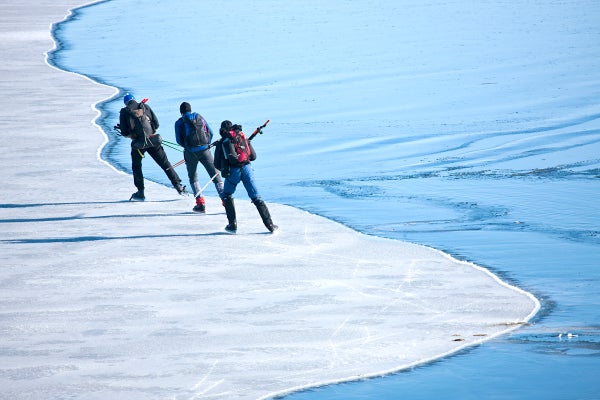
Ice skating, ice fishing, snowmobiling: These iconic winter activities are a way of life for many cold-climate communities. But in some regions, they may be on thin ice—literally.
New research suggests that winter drownings increase with rising winter temperatures. The warmer the air, the more likely it is that someone will fall through an unstable sheet of ice.
That means drownings could increase in cold countries as the climate continues to heat up, the study’s authors warn.
On supporting science journalism
If you're enjoying this article, consider supporting our award-winning journalism by subscribing. By purchasing a subscription you are helping to ensure the future of impactful stories about the discoveries and ideas shaping our world today.
Published yesterday in the journal PLOS ONE, the research documents more than 4,000 wintertime drowning incidents from 10 cold-climate countries across the Northern Hemisphere, including the United States, Canada, Finland, Sweden, Russia and Germany. In some countries, the data spanned several decades.
When analyzed alongside monthly winter climate data, several patterns emerged.
In general, drownings were rare in temperatures below 14 degrees Fahrenheit and above freezing—times when lake ice is at its most stable or when it melts away. They increased sharply as temperatures began to approach the freezing point.
Drowning rates tended to be highest at the beginning and end of winter—March or April in most of the 10 countries—when the weather is likely to be warmer.
The study shows that there’s a statistical relationship between winter temperatures and winter drownings—it doesn’t necessarily prove that the temperatures are the cause. But the researchers suggest that ice thickness is the most likely explanation. As temperatures rise, lake ice becomes less stable and less safe for sport or recreation.
That means rising winter temperatures could be a safety risk in cold climates, the authors suggest.
The study involved an international group of researchers working together to investigate the links between climate change, lake ice and human communities. The group had begun to look into the implications for winter recreation and cultural events, like ice fishing tournaments, when they realized that winter drownings might be worth investigating.
“This group of collaborators, we had a call every month,” said Sapna Sharma, the study’s lead author and a researcher at York University in Canada. “I remember saying to the group, ’Hey, we had a really tragic drowning through ice on a lake just north of Toronto where I live.’”
Collaborators in the United States and Sweden said similar incidents had occurred recently in their communities as well. The group began to wonder if there were any connections between winter drownings and winter weather.
Their findings suggest that cold-climate communities may wish to reassess the ways they regulate or communicate about winter recreation.
While drownings did generally increase as winter temperatures approached freezing, the rate of drownings still varied widely from one country to the next. The researchers noted that in countries with stringent rules about winter recreation—local laws in Italy, for instance, prohibit ice fishing and other activities—drownings were far less frequent.
On the other hand, the number of drowning incidents tended to be higher in places where winter activities have strong cultural ties, such as Indigenous communities in northern Canada. The researchers suggest that these communities may be at higher risk as winter temperatures rise.
The study provides a human angle to a phenomenon scientists are already tracking. Thinning and melting winter lake ice is already an expected consequence of climate change.
Last year, a study in Nature Climate Change suggested that just a few degrees of warming could cause thousands of lakes across the Northern Hemisphere to go from freezing reliably each winter to freezing only some of the time. Sharma also led that study.
“I think if I could make one recommendation, it would be to incorporate winter safety and winter ice safety into swimming lessons for children and teens,” Sharma suggested.
In general, she said, raising awareness about the dangers of warming winters is key to helping keep communities safe.
“It will just make more people aware that climate is changing, and it’s not happening just for the polar bears or for hurricane strength—it’s happening within our backyards and the lakes and rivers and creeks that we might spend time on in the winters,” she said. “And we need to adapt our behavior and our decisionmaking on whether a body of water is safe to use.”
Reprinted from Climatewire with permission from E&E News. E&E provides daily coverage of essential energy and environmental news at www.eenews.net.