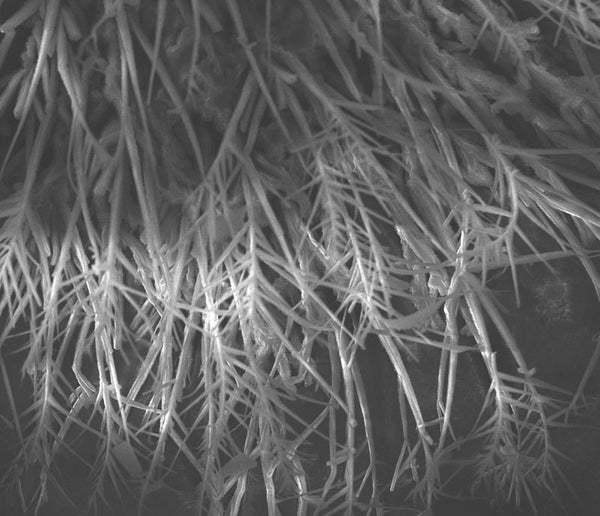
It looks like tiny tropical bamboo, or a new form of ocean coral. But this spikey strawlike structure is actually frozen water that may be found in outer space.
Courtesy of the American Astronomical Society
Join Our Community of Science Lovers!
On supporting science journalism
If you're enjoying this article, consider supporting our award-winning journalism by subscribing. By purchasing a subscription you are helping to ensure the future of impactful stories about the discoveries and ideas shaping our world today.
It looks like tiny tropical bamboo, or a new form of ocean coral. But this spikey strawlike structure is actually frozen water that may be found in outer space. Researchers at the Andalusian Institute for Earth Sciences at the University of Granada in Spain created this pine needle–like structure in the lab using a rapid-freeze technique inside an electron microscope. Ice in space forms at temperatures far more frigid than the coldest pockets on Earth—between 3 and 90 degrees Fahrenheit above absolute zero (–459.67 degrees F, or –273.15 degrees Celsius). This image was recently published in The Astrophysical Journal and provides a glimpse of the molecular organization of such tiny ice structures. Whereas Earth ice, like snowflakes, always form hexagonal crystals, space ice can form many different crystal shapes, such as this "palm tree" formation [right].
It’s Time to Stand Up for Science
If you enjoyed this article, I’d like to ask for your support. Scientific American has served as an advocate for science and industry for 180 years, and right now may be the most critical moment in that two-century history.
SciAm always educates and delights me, and inspires a sense of awe for our vast, beautiful universe. I hope it does that for you, too.
If you subscribe to Scientific American, you help ensure that our coverage is centered on meaningful research and discovery; that we have the resources to report on the decisions that threaten labs across the U.S.; and that we support both budding and working scientists at a time when the value of science itself too often goes unrecognized.