
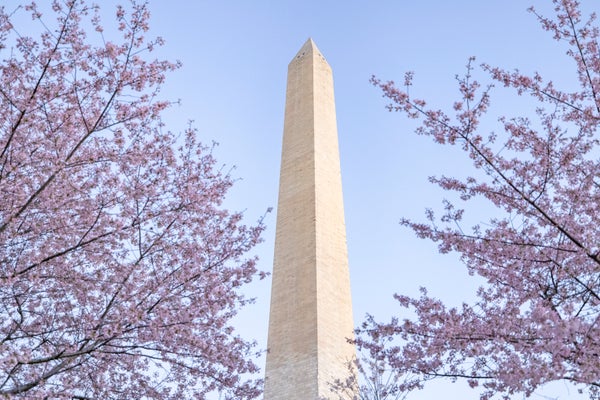
It’s officially spring in Washington, as the cherry blossoms are out in full force. But once again, they’re out earlier than expected.
The National Park Service announced Sunday that the famous blossoms around the Tidal Basin had hit their peak bloom. Scientifically speaking, that’s the point when at least 70% of all the blossoms have opened.
The peak arrived several days earlier than NPS had originally forecast, likely spurred on by above-average temperatures in the last week.
On supporting science journalism
If you're enjoying this article, consider supporting our award-winning journalism by subscribing. By purchasing a subscription you are helping to ensure the future of impactful stories about the discoveries and ideas shaping our world today.
It didn’t just beat this year’s forecast, either. It’s also nearly a week ahead of the average over the last 100 years, which typically falls around April 4.
Still, the early bloom is no big surprise. Cherry blossoms are highly sensitive to the weather—and as the climate has warmed, there’s been a long-term trend toward earlier blooms.
An EPA analysis, drawing on data from 1921 to 2016, found that the Tidal Basin blooms have shifted earlier by about five days over the last century.
That coincides with rising temperatures in the Washington area. Average temperatures there have risen by at least 2 degrees Fahrenheit in the last century.
The Tidal Basin cherry blossoms have a long legacy. The mayor of Tokyo, Yukio Ozaki, gifted 3,000 cherry trees to the United States in 1912 as a symbol of friendship between the two countries. Today, NPS estimates that the blooms attract around 1.5 million people each spring.
Across the sea, Japan’s own blossoms also are opening earlier.
The city of Kyoto has been carefully documenting its blooms for hundreds of years; its records date back to 812. It’s one of the world’s most complete records of the timing of spring—and it shows a clear pattern. The annual bloom has been happening earlier and earlier for the last 150 years or so.
As with the blooms in Washington, these trends have coincided with warming across Japan.
This year appears to have broken an impressive record. Kyoto’s peak bloom occurred on March 26, the earliest reported in 1,200 years.
Cherry blossoms are an obvious indicator of the changing climate, precisely because they’re so widely celebrated. But they’re hardly the only example. Numerous studies suggest that spring weather is coming earlier each year across much of the world.
Outside of the Tidal Basin, other national parks around the United States are feeling the heat. A 2016 study estimated the start of spring in national parks and protected areas by examining the date of the first leaf or first bloom from key plants, using records dating back more than a century. It found that spring is already advancing in three-quarters of the 276 parks included.
These early springs have the potential to affect natural ecosystems in a variety of ways. For one thing, different species don’t always adapt to climate change at the same pace, even if they’re otherwise closely intertwined. If a flowering plant blooms earlier in the season, but the bees or butterflies that pollinate it have not yet emerged, both organisms could suffer.
Earlier springs also can upset human recreation, the study pointed out—including the timing of annual flower festivals.
Reprinted from E&E News with permission from POLITICO, LLC. Copyright 2021. E&E News provides essential news for energy and environment professionals.