
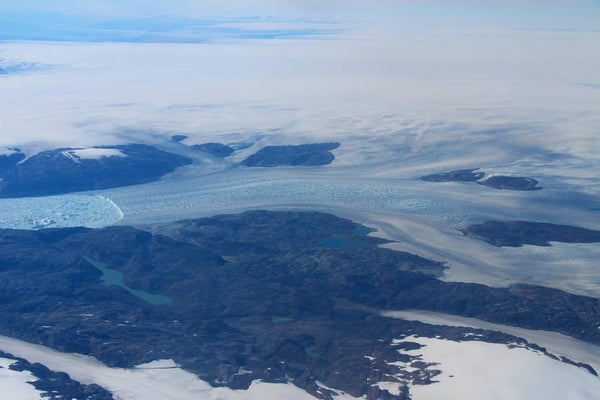
Aquifers in the Greenland ice sheet are channeling meltwater back into the ocean, new research indicates.
These “firn aquifers” were discovered by a group of NASA scientists in 2011. They comprise water pockets the size of Lake Tahoe and are embedded in the glacier’s surface, hidden under blankets of fresh snowfall and compressed ice. For the last few years, scientists have been trying to figure out what happens to this water—does it refreeze into the glacier, or does it trickle out somehow? Now, a researcher with NASA thinks she has the answer.
“The water enters crevasses—fractures that run all the way to the base of the ice sheet, which is a thousand meters thick—and then escapes into the ocean,” said Kristin Poinar, a postdoctoral fellow with NASA’s Goddard Space Flight Center.
On supporting science journalism
If you're enjoying this article, consider supporting our award-winning journalism by subscribing. By purchasing a subscription you are helping to ensure the future of impactful stories about the discoveries and ideas shaping our world today.
Poinar focused on the Helheim Glacier in southeast Greenland, but aquifers can be found in glaciers all over the world, including Svalbard and Alaska. They are located in the upper 50 meters or so of the ice sheet. Poinar used a computer model to show that cracks flowing with meltwater can travel all the way down to the bottom of the ice sheet, and then the ocean.
“Kristin’s finding is a key component in understanding the importance of the firn aquifer system. Her model shows that water is getting to the bed, and that adds a whole different level of significance to how that storage of water might affect changes in sea level rise in the future,” Rick Forster, a glaciologist, said in a statement.
Forster was part of the NASA team that discovered the aquifers six years ago.
Poinar’s conclusions are significant because they help scientists better understand how the Greenland ice sheet is melting. The water from the aquifers not only contributes to sea-level rise, but also causes the entire ice sheet to melt faster.
“The way the Greenland ice sheet is moving, the ice actually flows and forms under its own weight. It’s like leaving a ball of Silly Putty sitting on a table for a long time—it will flow under its own weight and flatten out. And when you get water underneath the ice sheet, it helps the ice deform faster and flow into the ocean at a faster rate,” explained Poinar. “We think this might be the significant contribution of how the aquifers affect global sea level.”
From a climate science perspective, the study helps create more accurate models to predict ice sheet melt rates. It also underscores the need to protect coastal areas from sea-level rise, said Poinar.
“Our economy is dependent on ports, and ports obviously exist in low-lying areas that are vulnerable to sea-level rise. This work—along with much of the work done at the lab in NASA—is able to directly inform making better ice sheet models that can even more accurately forecast sea-level rise that we’re likely to see in the next decades,” she said.
Reprinted from Climatewire with permission from E&E News. E&E provides daily coverage of essential energy and environmental news at www.eenews.net.