
Laurence Corash, chief medical officer of Cerus Corporation, provides the following explanation:
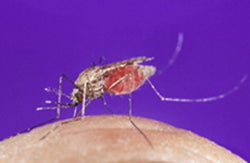
Image: JIM GATHANY/CDC
MOSQUITOES do not provide HIV with the T cells the virus needs in order to replicate. |
The AIDS virus (HIV) on used needles is infectious when injected into a human where the virus can bind to T cells and start to replicate. The human T cell is a very specific host cell for HIV. When a mosquito feeds on a person with HIV in his or her blood, the HIV enters the insect's gut, which does not contain human T cells. The virus thus has no host cell in which to replicate and it is broken down by the mosquito's digestive system.
On supporting science journalism
If you're enjoying this article, consider supporting our award-winning journalism by subscribing. By purchasing a subscription you are helping to ensure the future of impactful stories about the discoveries and ideas shaping our world today.
The single-celled parasite that causes malaria, in contrast, can survive and multiply in the mosquito's gut and mature into an infectious form. The resulting sporozoites then migrate to the insect's salivary glands. Because mosquitoes inject their saliva when they bite, the parasite is passed along to the next human the insect feeds on. In this case the complex interaction between the infectious agent and the vector (the mosquito) is required for transmission. HIV, however, deteriorates in the gut before the mosquito bites again and therefore is not transmitted to the insect's next victim.