
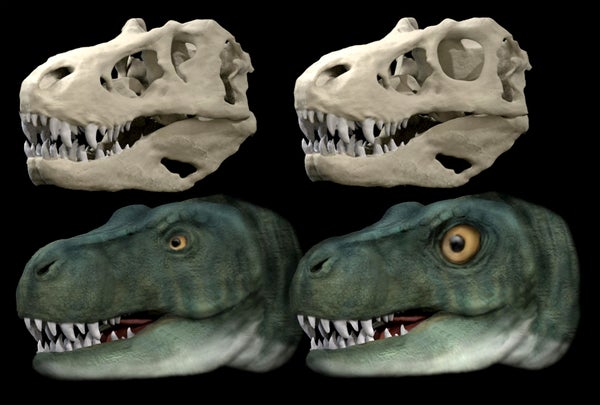
It was an unlucky dinosaur that came face-to-face with the beady-eyed glare and giant, toothy grimace of the iconic Tyrannosaurus rex. But the seven-metric-ton predator, which hunted through the end of the Cretaceous period 65 million years ago, was not the only beast with these features: other large predatory dinosaurs also gazed through small eyes in their large head. A new study suggests that those squinty eyes could be a trade-off for powerful chomping jaws.
Paleobiologist Stephan Lautenschlager of the University of Birmingham in England discovered this connection while digging through skull measurements of hundreds of extinct archosaurs—the taxonomic group that includes birds, crocodiles and all of their ancestors. Such skulls can reveal a lot about an animal. A fossilized skull’s eye socket gives scientists a good idea of eye size. For instance, a T. rex’s skull cavities would have accommodated eyes about the size of oranges in its meter-long head. These proportions likely evolved because of its skull size: if one of a T. rex’s eyes took up 20 percent of its skull in the same way some smaller dinosaurs’ eyes do, “we would have a massive eyeball 30 centimeters in diameter and 20 kilograms heavy,” Lautenschlager says. Such large eyes could potentially consume up to 15 percent of the animal’s metabolic energy, meaning it would have to eat more just to maintain its huge eyeballs. “This is probably not efficient, even though it might increase the vision acuity,” Lautenschlager adds.
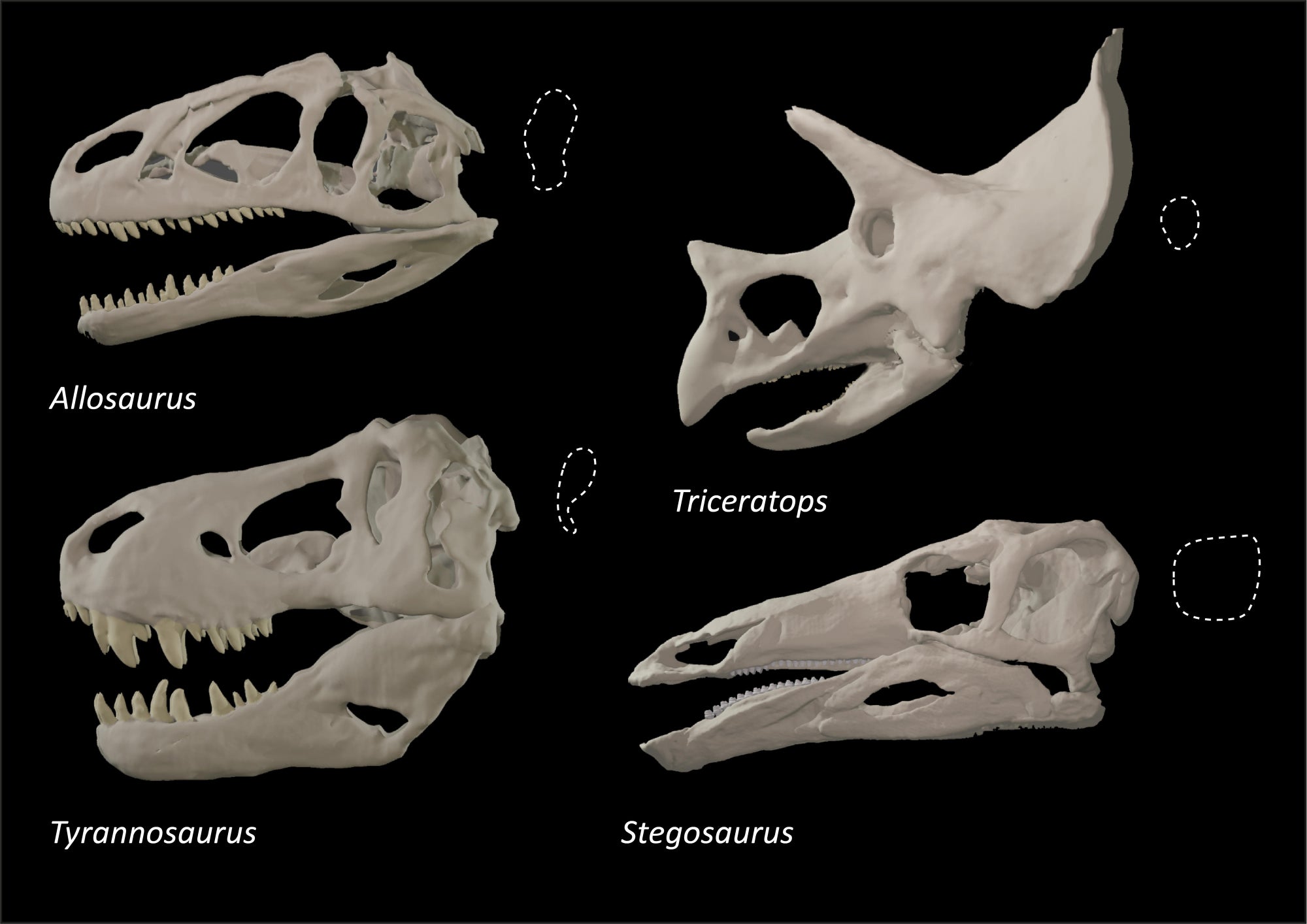
Skulls of different dinosaurs showing variation in eye socket shape (stippled outline) Credit: Dr Stephan Lautenschlager, University of Birmingham
On supporting science journalism
If you're enjoying this article, consider supporting our award-winning journalism by subscribing. By purchasing a subscription you are helping to ensure the future of impactful stories about the discoveries and ideas shaping our world today.
The eye socket’s shape is telling, too. Unlike modern animals’ round eye sockets, in large carnivorous dinosaurs, “we see all these strange eye socket orbital shapes,” Lautenschlager says. These can range from cavities that look like keyholes to compressed circles to wedge shapes, which all fit smaller eyes than could same-sized round sockets. For his study, published on August 11 in Communications Biology, Lautenschlager cataloged eye-socket size and shape from 410 previously documented archosaur skulls and modeled how varying sockets would affect the stresses that eating put on those skulls.
Beyond just dinosaurs, other large archosaur predators during the same era also had unusual socket shapes. This appears to be convergent evolution, Lautenschlager says, where the different species independently evolved away from round eyes. Using biomechanical computer modeling, he found that these unusual shapes could have minimized the biomechanical stress on the animals’ skulls when they feasted on their prey. “It seems like, really, this is an adaptation to deal with high forces during biting,” he says, “so that the skull is not in danger of deforming or being stressed too much.”
Lautenschlager also noted in the study that the shape of a T. rex’s eye socket changed over its life span, starting out rounder and taking up more of its skull in youth. Much like infant animals today, a baby T. rex would gaze up to a parent with big, round eyes. “I think that’s a general theme throughout the animal kingdom,” Lautenschlager says. But as the young T. rex grew into an adolescent and eventually reigned supreme in its ecosystem, the animal’s eye sockets became keyhole-shaped.
This change supports the hypothesis that eye-socket shape might be based on the power of an animal’s bite, says Randy Irmis, curator of paleontology at the Natural History Museum of Utah, who was not involved in this work. As a newly hatched T. rex, you could easily get away with circular eye sockets because “you’re eating small prey, your body size is small, you’re not facing the same functional constraints that the adult is,” he says. Other smaller or herbivorous archosaurs would similarly not need strangely shaped eye sockets. “Based on the data presented, it seems to be a compelling explanation that [eye-socket shape is] sort of this combination of body size and diet,” Irmis says.
Paleontologist Jingmai O’Connor of the Field Museum in Chicago, who also wasn’t involved in the study, is not entirely convinced of this diet-based explanation and suggests a dinosaur’s size may have played a large role. “If you take a circular [eye socket] in a flat skull and stretch the skull so it is taller, then the orbit becomes oval,” she says. And the biomechanical stress and strain model that Lautenschlager used “assumes the skull is a single homogenous unit, which is far from reality.” Although this model does not account for joints and muscles in and around bones, O’Connor says, it is still widely used in paleontology because there is no good alternative.
More advanced technologies and models will inevitably illuminate new information from fossils, Lautenschlager says, and future research could consider “how orbit size changes with skull height, length or width.” For now, he points out that the eye sockets of the large herbivores he studied remained fairly circular while their carnivorous counterparts diverged toward stranger shapes. In fact, his favorite dinosaurs in the study had weirdly round eye sockets: vegetation-munching ceratopsians. “I found it fascinating that they actually adapted their skull in such a way that it’s nearly a perfect circle,” he says.