
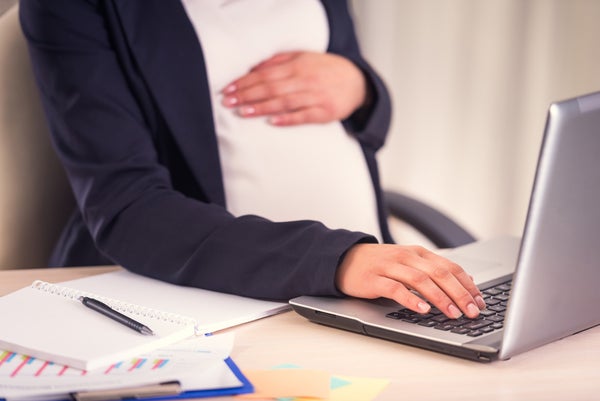
In September Pres. Donald Trump announced during his election campaign that he would guarantee six weeks of paid maternity leave for working mothers—the first time a Republican presidential candidate has made such a promise. But even if he keeps his word, such a policy may not help many new moms, according to a new study published in the American Journal of Public Health.
Jay Zagorsky, an economist and research scientist at The Ohio State University, analyzed data from an employment survey given to 60,000 U.S. adults each month to find out how maternity leave trends have changed over time. What he found was surprising: Even though five states—California, New Jersey, Rhode Island, and Washington, along with New York (whose new legislation goes into effect next January)—have passed laws requiring paid family leave since 2002, the overall percentage of American women taking maternity leave has not budged since 1994. Among new mothers, “there’s no trend upward or downward over time,” he says. (He did find that about three times more men took paternity leave in 2015 than in 1994.)
Overwhelming evidence suggests maternity leave benefits both moms and kids. Babies born to leave-taking moms are more likely to survive, get immunized and be breastfed. Moms who take leave also end up mentally and physically healthier. For these reasons, the United Nations’ International Labor Organization (ILO) recommends countries provide no less than 14 weeks of paid maternity leave. In 2015 they reported 186 out of 188 countries do provide at least some paid leave—with the exceptions being Papua New Guinea and the U.S. The Family Medical and Leave Act of 1993 mandates 12 weeks of maternity leave for working moms in the U.S. but only about 60 percent (pdf) of the workforce actually qualifies under the law’s stringent criteria, and the leave it guarantees is unpaid.
On supporting science journalism
If you're enjoying this article, consider supporting our award-winning journalism by subscribing. By purchasing a subscription you are helping to ensure the future of impactful stories about the discoveries and ideas shaping our world today.
Zagorsky’s new findings suggest paid leave policies do not necessarily encourage more women to take time off. But why? Some women may forgo leave out of a fear that they will be overlooked for promotions. “There could be an office culture in which if you really want to show that you’re serious about your job, you shouldn’t take leave, or take all of it,” says Megan Sholar, a political scientist at Loyola University Chicago and the author of Getting Paid While Taking Time: The Women’s Movement and the Development of Paid Family Leave Policies in the United States. Others may be scared of getting fired: The New Jersey Department of Labor and Workforce Development, for example, states on its Web site that its paid family leave program “does not protect anyone’s job.” Also, maternity leave laws are not always put into effect. Washington State passed a law in 2007, but it has not been implemented (pdf) due to lack of funding.
And even if leave is paid, many parents may not feel they can afford to take it. In California parents on leave receive only about 55 percent of their full pay. “Right when your costs are going up—not only medical bills but diapers and food—your income is going down, so that certainly could dissuade some people from taking leave,” Sholar notes. The low pay of paid leave also helps to explain another of Zagorsky’s findings: that women who take maternity leave tend to be white and more highly educated than women who do not, two characteristics that are associated with greater wealth.
But there is a silver lining. Paid leave policies do seem to be effective at encouraging women who do take it to stay home longer. A 2013 study found that after California instituted its paid leave policy, the average leave length doubled from three weeks to six. And a 2016 analysis suggests New Jersey’s paid leave policy has helped close its wage gap between women and men—possibly, the authors wrote, because it fosters a “deeper attachment” to the workforce in the long run. “Even if the total number of women taking leave doesn't increase substantially immediately after the passage of paid leave, we shouldn't overlook all of the other benefits,” Sholar says.
Zagorsky—who was inspired to conduct his study after one of his nieces, who worked at a large company, was not given paid leave—says he hopes his findings will spark much-needed discussions about U.S. maternity leave policies. “We’ve had some conversations about maternity leave but many of them haven’t been grounded in data yet,” he says. He created an 18-page online appendix to accompany his new paper, giving step-by-step instructions to other scientists who might want to use the same data source to conduct additional studies. The more information we have on this complex topic, the easier it will be for lawmakers to create policies that truly make a difference.