
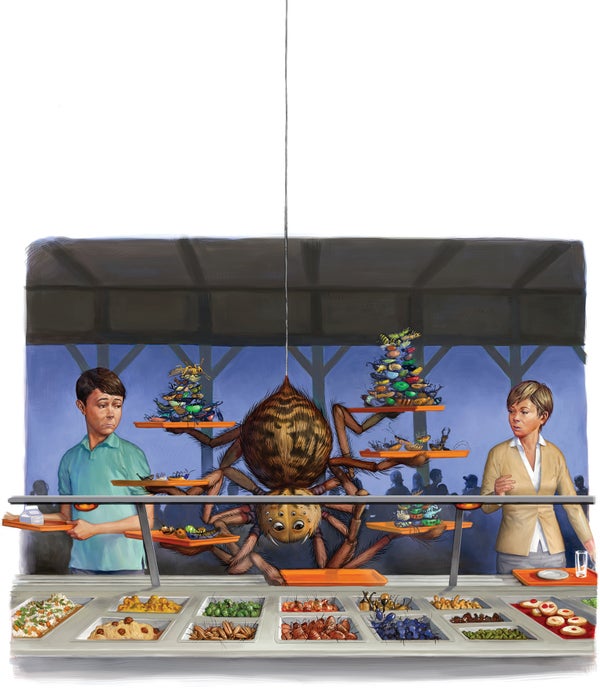
The United Nations puts the current population of planet Earth at around 7.5 billion people. Seems like a large number. But there are way more spiders. By the way, now would be a good time to stop reading if you suffer from arachnophobia.
The April issue of the journal The Science of Nature featured a study that tried to determine how much prey the world's spider population puts away annually. The work was done by Martin Nyffeler of the University of Basel in Switzerland and Klaus Birkhofer of Sweden's Lund University and Germany's Brandenburg University of Technology Cottbus-Senftenberg.
Switzerland and Germany are places that have a lot of spiders. So is any given forest. And the Arctic tundra. And your house. Because almost every place is a place that has a lot of spiders. American Museum of Natural History arachnologist Norman Platnick once wrote, “Wherever you sit as you read these lines, a spider is probably no more than a few yards away.” As most spiders have eight eyes, it's probably looking at you, too.
On supporting science journalism
If you're enjoying this article, consider supporting our award-winning journalism by subscribing. By purchasing a subscription you are helping to ensure the future of impactful stories about the discoveries and ideas shaping our world today.
Back to Nyffeler and Birkhofer. Just as you need to know how many people are coming to dinner before you know how much food to prepare, the spider speculators needed to come up with an estimate for the planet's spider population before they could try to determine how much all those spiders ate. They perused the known literature and found 65 previous publications tallying the biomass of spiders in seven particular habitats, ranging from grasslands to farms to deserts to the aforementioned forests and tundra. They pooled the data (if you have a pool, it's got spiders) and came up with 25 million metric tons of spiders worldwide.
The researchers did not report numbers of individuals represented by their gross (and I mean that) tonnage. So I did a rough calculation: 25 million metric tons (total spider weight) divided by an itsy-bitsy bit (the weight of the average spider) comes out to eleventy bazillion spiders. More or less.
The spider-men then used two techniques to count up what spiders collectively eat. The first method had them simply compute how much prey all the world's spiders would need to perform their necessary life tasks, such as climbing up waterspouts, trying to get flies to check out their parlors, and sitting down beside hungry young women parked on tuffets. That approach led them to a figure of about 700 million metric tons annually. Which they downgraded to only 460 million metric tons, assuming that spiders would avoid hunting on the estimated one third of days that included precipitation—said spiders instead preferring to wait until out came the sun and dried up all the rain.
Method two had the arachnophiliacs round up “published studies of the annual prey kill of spider communities in various biome types.” Eighteen previous assessments in various biomes offered enough raw data to place the annual prey amount in a range of 400 million to 800 million metric tons. Which means the two estimation procedures arrive in the same ballpark. (Not League Park, home to Major League Baseball's 1899 Cleveland Spiders, who crawled to a wretched record of 20–134.)
Much of the press coverage of this study noted that the world's spiders could consume every person on Earth (less than 300 million metric tons total) and still be hungry. But spiders do not show any predilection for human flesh, preferring the taste of insects and another small beastie called collembola, or springtail. So counting on spiders for population reduction is a bad plan.
In fact, Nyffeler and Birkhofer avoided talk of humans as food, although they did cite a 1958 paper that claimed that British spiders ate more weight in insects than the combined weight of all Britons. Keep calm and nom, nom, nom.
The researchers actually hoped “that these estimates and their significant magnitude [would] raise public awareness and increase the level of appreciation for the important global role of spiders in terrestrial food webs.” And that their work would “emphasize the important role that spider predation plays” in controlling “many economically important pests and disease vectors.”
So when you see a spider in your home, you could stomp it. Or put it outside. Or you could thank it and wish it bon appétit!