
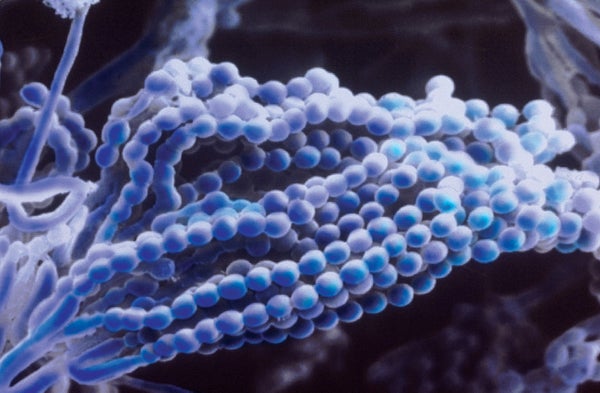
U.S. states have long designated their own official flowers, birds and mammals, local symbols that fire up affection or pride. Now the Illinois legislature has taken things to the next (microscopic) level by adopting Penicillium rubens —a mold that produces penicillin—as the official state microbe.
Scottish microbiologist Alexander Fleming discovered in 1928 that a fungus called Penicillium notatum produced penicillin, which became the world's first widely effective antibiotic. But P. notatum could not generate large-scale quantities of the drug, which became especially crucial when World War II broke out. So scientists at the University of Oxford sought help from the U.S. Department of Agriculture's Northern Regional Research Laboratory (since renamed the National Center for Agricultural Utilization Research, or NCAUR), in Peoria, Ill. Andrew Moyer, a microbiologist there, took on the problem.
Moyer's fellow researcher Mary Hunt found a moldy cantaloupe at a Peoria market and brought it to the lab for analysis, says NCAUR biochemist Neil Price, who championed the state microbe designation. As was the case with many women conducting research in that era, Hunt's contribution to the discovery and study of that mold—which turned out to be Penicillium rubens —was diminished at the time. Moyer's 1944 publication on P. rubens mentions Hunt only in the paper's acknowledgments, and the press referred to her as “Moldy Mary.” P. rubens could better tolerate a new fermentation process that let it quickly produce hundreds of times more penicillin than previously studied strains, which let the Allies massively scale up antibiotic production. The same strain is still used to manufacture penicillin today, Price says. “To think—a moldy cantaloupe from a fruit market in Peoria revolutionized the medical field for millions of people,” says State Representative Stephanie Kifowit, who co-sponsored the Illinois House version of the P. rubens bill.
On supporting science journalism
If you're enjoying this article, consider supporting our award-winning journalism by subscribing. By purchasing a subscription you are helping to ensure the future of impactful stories about the discoveries and ideas shaping our world today.
Price discussed his idea for making P. rubens the state microbe with State Senator David Koehler, who ultimately sponsored the Senate version of the bill. “I thought, ‘We have a state bird,’” Price says. “‘Why not a state microbe?’” Illinois is only the third state to take this step, joining the ranks of Oregon (which similarly honors Saccharomyces cerevisiae, or brewers' yeast) and New Jersey, whose state microbe Streptomyces griseus also produces an antibiotic. Some efforts to designate official microbes have faltered: Wisconsin failed to pass legislation honoring Lactococcus lactis in 2010, and Hawaii was unable to choose between Flavobacterium akiainvivens and Aliivibrio fischeri in 2013.
But the Illinois effort attracted bipartisan support and sailed through both houses of the General Assembly, passing unanimously in May. The P. rubens discovery “is an important part of Illinois history,” Koehler says. “I am glad to know that it will be forever tied to the state as our official microbe.”