
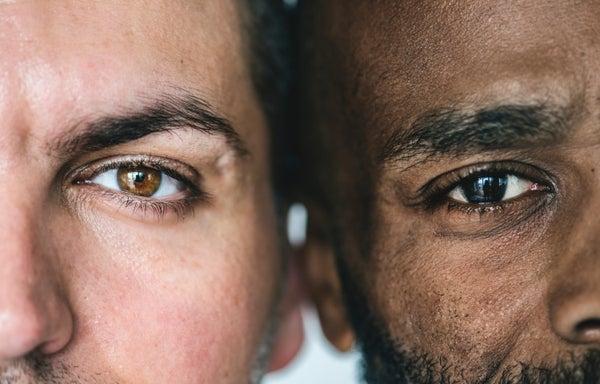
Psychologists have lots of evidence that implicit social biases—our automatic, knee-jerk attitudes associated with specific races, sexes and other categories—are widespread, and many assumed they do not evolve. The feelings are just too deep. But a recent study finds that over roughly the past decade, both implicit and explicit, or conscious, attitudes toward several social groups have grown warmer.
The study used data from a standard test of implicit attitudes collected via a Web site called Project Implicit. Participants were asked to quickly press a certain computer key in response to positive words, such as “happy,” and a different key in response to negative words, such as “tragic,” that appeared on a screen. These words were interspersed with images or words that represented two categories of people, such as Black and white, and participants were asked to flag these using the same keys. Faster reactions when, for example, Black rather than white faces shared a key with negative words suggested a racial bias.
Tessa E. S. Charlesworth and Mahzarin R. Banaji, psychologists at Harvard University, analyzed more than four million results collected over a 10-year period from U.S. adults who had taken implicit association tests for sexuality, race, skin tone (in which faces differ in color but not shape), age, disability and body weight. Respondents also answered questions on the screen asking them to explicitly rate how much they liked people in each of the categories.
On supporting science journalism
If you're enjoying this article, consider supporting our award-winning journalism by subscribing. By purchasing a subscription you are helping to ensure the future of impactful stories about the discoveries and ideas shaping our world today.
In line with previous findings, explicit bias decreased in all six categories from 2007 through 2016; the drop ranged from 49 percent (for sexuality) to 15 percent (for body weight). But more surprisingly, implicit bias also decreased—by 33 percent for sexuality, 17 percent for race and 15 percent for skin tone (graphic). Most of the reductions occurred in all generations, the researchers reported in a study published online in early 2019 in Psychological Science. “It's a really cool paper,” says Keith Payne, a psychologist at the University of North Carolina at Chapel Hill, who has found similar bias reductions in his own work. “I think it's going to start a lot of conversations.”
Charlesworth and Banaji also found, however, that implicit biases about age and disability did not change over time, and those against overweight people nudged up by 5 percent.
Several factors might explain the discrepancies among categories, the researchers say. In their data set, implicit biases for race, skin tone and sexuality were lower to begin with than those for age, disability and body weight. And the types of implicit biases that decreased the most are also the biases that have received more societal attention. Meanwhile the stigma associated with obesity may have increased in recent years.
Next the team plans to explore implicit and explicit attitude change across demographics and geographical regions, as well as whether there is evidence that trends are related to political polarization.

Credit: Amanda Montañez; Source: “Patterns of Implicit and Explicit Attitudes, Vol. I: Long-Term Change and Stability from 2007 to 2016,” by Tessa E. S. Charlesworth and Mahzarin R. Banaji, in Psychological Science, Vol. 30, No. 2; February 2019