
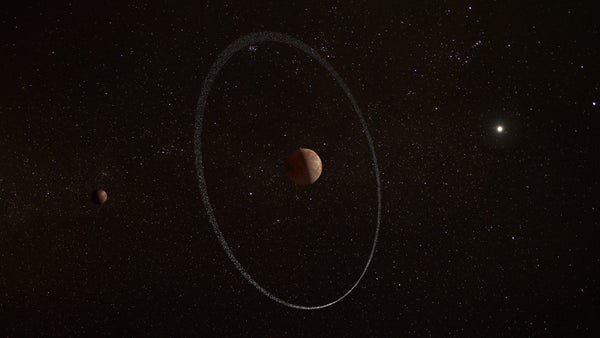
Astronomers have discovered an entirely new ring system within the solar system, and it's located at such a great distance from its dwarf planet parent that it should be impossible.
The ring surrounds Quaoar, which is around half the size of Pluto and located beyond Neptune. It is only the third ring to be found around a minor planet and the seventh ring system in the solar system, with the most famous and well-studied rings surrounding the giant planets Saturn, Jupiter, Neptune and Uranus.
"The six [previously known] planets with ring systems all have rings which are quite close to the surface of the planet. So this really challenges our ring formation theories," study co-author Vik Dhillon, a professor of physics and astronomy at the University of Sheffield in England, told Live Science. "It was previously thought to be impossible to have rings that far out, so in a nutshell, the ring of Quaoar is a real challenge to explain theoretically."
On supporting science journalism
If you're enjoying this article, consider supporting our award-winning journalism by subscribing. By purchasing a subscription you are helping to ensure the future of impactful stories about the discoveries and ideas shaping our world today.
Related: Ghostly rings of Neptune shine in new James Webb Telescope images
The ring system is located at a distance of seven planetary radii away from Quaoar (that is, seven times Quaoar's radius), which is twice as far out as the theoretical maximum limit for a ring system, known as the Roche limit. For comparison, the main part of Saturn's rings sits at just three planetary radii from the gas giant.
Previously, it was thought that rings past the Roche limit wouldn't be able to survive this far out from their parent body.
"Rings that are formed outside Roche limits aren't meant to be stable; they should rapidly accrete into moonlets, using up all the ring material," Dhillon said. "With this discovery, we have a ring not just outside the Roche limit, but way beyond it."
The team's findings were published Feb. 8 in the journal Nature.
How a dwarf planet grew a distant ring
Dhillon and the team think Quaoar's ring formed similarly to other solar system rings: Collisions of moonlets orbiting the parent planet created debris that settled into a ring made of rock, ice and dust particles.
These particles can't reform a moonlet if they are close to the planet and within the Roche limit, because tidal forces from the parent body constantly rip them apart and prevent them from clumping, according to the researchers. But that can't be the case with Quaoar's ring.
"We've got to find some way of stopping that moonlet forming that far out," Dhillon said. "The particles in the ring are colliding all the time, and if these collisions are elastic, it means the particles can't stick together to form a moonlet." (An elastic collision is one in which two colliding objects bounce away from each other rather than clumping together, like a rubber ball hitting a floor.)
Elastic collisions may be possible if the ring particles have an icy outer coating, Dhillon said — something that is plausible, given Quaoar's location at the edge of the solar system. However, more data are needed to confirm this idea.
A chance discovery
The researchers discovered the ring system while investigating whether Quaoar has an atmosphere. The team used the high-speed HiPERCAM instrument on the Gran Telescopio Canarias), a telescope in Spain's Canary Islands that can spot small variations in light from background stars. The ring became visible when it caused a roughly 5% to 10% dip in light from a background star, both before and after the main body of Quaoar passed in front of the star. This event, known as an occultation, lasted less than a minute.
"The discovery came as a bit of a surprise," Dhillon said. "We knew there was a possibility we might find them, but we weren't really looking for them."
The ring of Quaoar is too small and too faint to be seen via direct imaging, even with an instrument as powerful as the Hubble Space Telescope. Dhillon added that other than occultation events, the only way to spot these dwarf planet rings would be to send a robotic probe to visit them.
"This discovery shows you the amazing diversity of things that are in our own cosmic backyard," Dhillon said. "You don't have to look light-years away into the distant universe to find the unexpected. Surprises are still aplenty in our own solar system.”
Copyright 2023 Live Science, a Future company. All rights reserved. This material may not be published, broadcast, rewritten or redistributed.