
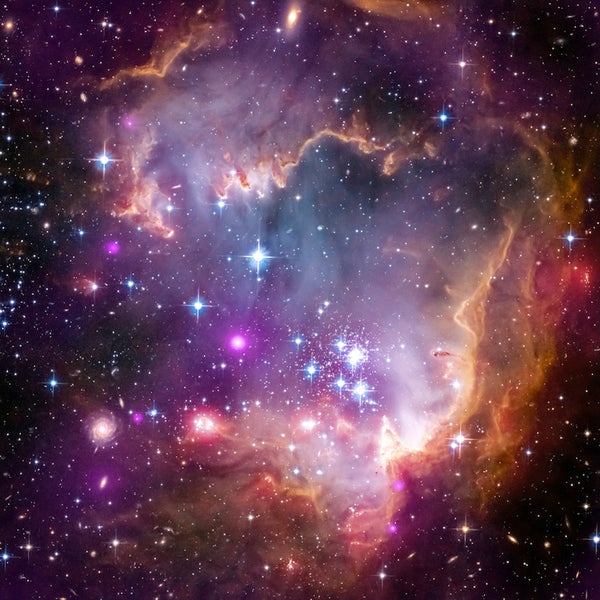
Newborn stars light up the outskirts of our galactic neighbor in this stunning NASA image, released April 3. Sitting 200,000 light-years away in a remote corner of the Small Magellanic Cloud, star cluster NGC 602 fills the frame and glows with x-ray, visible and infrared light from a host of stellar infants.
About 160 light-years across, NGC 602 is a stellar nursery. Vast hydrogen clouds (orange) swirl, fracture and collapse. New stars emerge and fierce stellar winds sculpt the gas to form bubbles and filaments. Strong magnetic fields heat the gas to millions of degrees and it releases x-rays (purple) in response. Pockets of interstellar dust, shielded by the hydrogen, slowly bake and glow with infrared light (red).
In this image data from three of NASA’s spaceborne Great Observatories combine to capture the action. Purple shows x-rays picked up by the Chandra telescope. Red, green and blue map the visible light seen by Hubble. The Spitzer telescope provides a peek at infrared light, also shown in red. Both the x-ray and infrared colors are computer-generated. The blue and white dots are stars within, in front of and behind the nebula. Smudges of reddish light are more distant galaxies, some hundreds of millions of light-years away. A spiral galaxy peeks out from the lower left corner.
On supporting science journalism
If you're enjoying this article, consider supporting our award-winning journalism by subscribing. By purchasing a subscription you are helping to ensure the future of impactful stories about the discoveries and ideas shaping our world today.
The stars in the nebula are young, only five million years old. Some have not yet emerged from their hydrogen cocoons. The infrared light seen by Spitzer shows these deeply embedded protostars switching on. It also traces gigantic wisps of dust grains heated by the ambient radiation. X-rays come from very hot gas pumped to an excited state by the young stars’ strong magnetic fields. This marks the first time astronomers have seen this phenomenon occurring in another galaxy.
NGC 602 sits in “the wing” of the Small Magellanic Cloud: a satellite galaxy of the Milky Way. It’s an interesting place to watch stars form because astronomers think it mimics conditions in the early universe. Compared with the Milky Way, there’s not a lot of gas and dust to work with. The composition of the clouds is closer to primordial: more hydrogen and helium mixed with less of the heavier elements like oxygen, carbon and sodium. Composite images like this provide astronomers with a unique window into the universe’s early years and a peek at how galaxies form.
—Christopher Crockett