
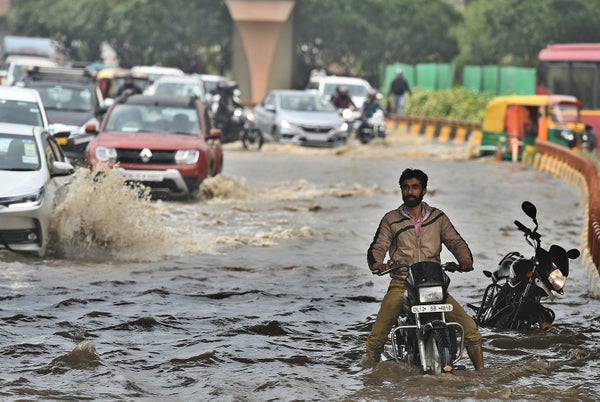
Small levels of global warming can increase the likelihood of extreme events, new research warns. That’s prompting scientists to question how accurately disasters in the recent past can be used to predict extreme events today.
A study published Wednesday in Science Advances suggests that some research attributing climate change to individual disasters has underestimated the probability of certain extremes in the last decade. That’s especially true of unprecedented hot and wet events.
That’s because researchers were basing their analyses on a historical study period extending only up to the year 2005, said author Noah Diffenbaugh, a climate scientist at Stanford University. As it turns out, the warming that’s occurred since then has had a big impact on global extreme events.
On supporting science journalism
If you're enjoying this article, consider supporting our award-winning journalism by subscribing. By purchasing a subscription you are helping to ensure the future of impactful stories about the discoveries and ideas shaping our world today.
“The global warming, even just in the 21st century, has created such a substantial increase in the frequency of extreme hot and extreme wet events over these regions that those frequencies fall well outside of the [previously] predicted probabilities,” Diffenbaugh told E&E News.
Studies investigating the influence of climate change on extreme events often use climate models to conduct their analyses. A common method is to run two series of simulations—one based on historical climate data reflecting the real-life progression of climate change over time, and one based on an imaginary world in which climate change does not exist.
The difference between the two simulations can reveal the way climate change affects the probability of extreme events occurring around the world.
One of the most commonly used model suites is an ensemble known as CMIP5—it was developed by an international team of scientists and has served as the basis for countless climate impact studies. The issue is that CMIP5’s historical simulations only reflect data up to 2005.
That’s not a flaw in the models’ design; it’s just the information that was available when they were first being developed. A new suite of climate models, known as CMIP6, is in development and will reflect an up-to-date historical climate period.
It means that analyses relying on CMIP5’s historical climate period don’t necessarily account for the warming that has occurred since 2005.
Diffenbaugh’s study presents a new method for checking predictions made in previous papers that relied on data from the past. These include some of his own past work, which used CMIP5 simulations to estimate the influence of climate change on extreme heat and precipitation events in the historical period and made predictions about future extremes.
Wednesday’s study suggests that predictions based on data from the past can substantially underestimate the probability of extremes in the present. This was the case for record-breaking hot and wet events in the Northern Hemisphere between 2006 and 2017, Diffenbaugh found.
“One implication of these results is the present probabilities are potentially closer to the period going forward ... than they are to the previous two decades,” he said.
Diffenbaugh added that the method outlined in his paper isn’t limited to checking studies based on CMIP5 simulations ending in 2005.
That was the main example used to illustrate the point in the new study. But the method could be used to evaluate other predictions based on data from earlier historical periods, just as long as the time window in which the predictions were made has already passed.
The study’s findings aren’t particularly surprising, other experts say.
“Of course the role of climate change is larger than originally estimated if you have another 10 years of warming in the data,” said Friederike Otto, an expert on climate change and extreme events at the University of Oxford, in an email.
But the size of the effect is worth pointing out, added Sebastian Sippel, a climate extremes expert at the Swiss Federal Institute of Technology in Zurich.
“The finding of this study, which in a sense is expected but in a sense is also kind of surprising, is how strong the change is,” he said.
According to Diffenbaugh, the paper could have practical applications for community planners working to address the impacts of climate change.
If people are designing infrastructure or making other decisions using recent climate data, instead of future climate projections, they could be significantly underestimating the consequences of global warming.
“That’s kind of the crucial point of this paper, is that climate change has to be taken into account, even on time scales of 10 years or so,” Sippel added.
The paper serves as yet another “wake-up call” about the speed at which climate change is progressing on Earth, he noted.
“The expectation that the next 10 years would be broadly the same as the last 20 or 30 years—this just cannot be expected anymore,” Sippel said.
Reprinted from Climatewire with permission from E&E News. E&E provides daily coverage of essential energy and environmental news at www.eenews.net.
