
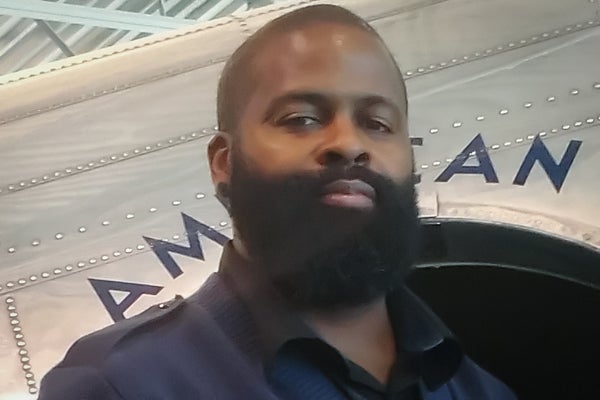
Laeon Israel is a professional cybersleuth. As a senior forensic analyst at Charles Schwab, he is responsible for bringing to light information that will be used in the prosecution of financial crimes. And he came to this by way of an aircraft carrier.
In the 1990s Israel was a Navy deck seaman onboard the U.S.S. Enterprise. His role was to help with the upkeep of the physical ship—all 1,123 feet of it. He said it was a moment in one of the ship’s computer labs that completely changed his course. “I logged on to the computer and started to see things,” he says. “I took a look at the people who were working in the department..., and I said to myself, ‘What are you doing?’”
Israel was in paint and grease-smeared coveralls. The people hesaw were in “pressed pants, ironed shirts—they looked sharp,” he says. But the difference in garb just snapped his mind to attention. What drew him in were the answers he got to the flood of questions he let loose at his shipmates working at the computer lab. Operating systems, electrical circuits, Internet connectivity, cryptography—immersed in these subjects, he found the start of his path in computer science and his conversion to a career in STEM (science, technology, engineering and mathematics).
On supporting science journalism
If you're enjoying this article, consider supporting our award-winning journalism by subscribing. By purchasing a subscription you are helping to ensure the future of impactful stories about the discoveries and ideas shaping our world today.
Click here to watch an extended version of the interview.
When asked about whether his current experience in STEM differs from when he first entered the field, Israel explains that some things have changed for the better—and others have not. He believes that the tech industry is now very “fertile” for people looking for a career.
He also sees the need for more progress. “In STEM, there are still disparities in regards to people of color,” he says. “As long as we keep pushing and moving the ball forward, there’ll be change, there will be better days.” And he points to his employer as a shining example of a corporation that is trying to close the diversity gap in real time.
But one company alone does not constitute the sea change that Israel wants. He still believes that the topic of diversity, equity and inclusion in STEM should be a priority in many industries. To him, that also means that many science- and technology-focused industries still feel unwelcoming to people of color. Yet recent events—such as the murder of George Floyd—have led to what he calls “a renewed spark in education and racial inequality.” For Israel, the question remains: When this wave fades, what happens next?
This discussion is part of a speaker series hosted by the Black Employee Networkat Springer Nature, the publisher of Scientific American. The series aims to highlight Black contributions to STEM—a history that has not been widely recognized. It will cover career paths, role models and mentorship, and diversity in STEM.