
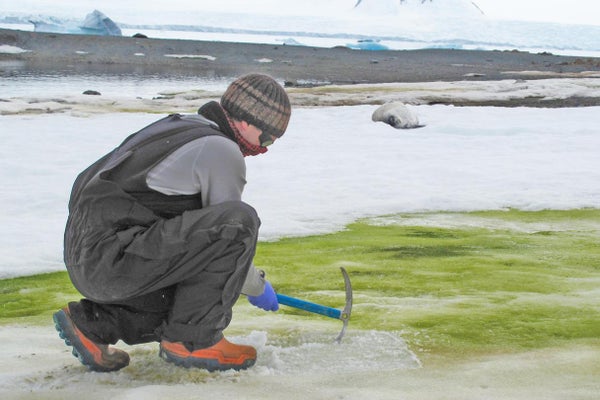
Green snow algae are some of Antarctica’s smallest living organisms, delicate enough to examine by microscope. But when they grow together in clumps, they’re visible from space—a rich, green stain on the surface of the white snow.
Now, scientists are using satellite images to determine how much algae is growing in Antarctica. One of these first-ever mapping projects was published this week in the journal Nature Communications.
It identified a large network of algal blooms, cropping up each summer across the peninsula of Antarctica and the nearby islands that dot the Southern Ocean. The researchers counted a total of 1,679 individual blooms, with the largest sometimes covering hundreds of square meters.
On supporting science journalism
If you're enjoying this article, consider supporting our award-winning journalism by subscribing. By purchasing a subscription you are helping to ensure the future of impactful stories about the discoveries and ideas shaping our world today.
These blooms likely play an important role in the coastal ecosystem. Algae are typically a fundamental part of coastal food webs and help to sustain other larger forms of life.
The study suggests they may also be a small but notable part of the Antarctic carbon cycle, sucking up several hundred tons of carbon each summer (although much of this carbon may be released again once the algae die or are eaten).
Scientists already knew that snow algae were a part of the coastal Antarctic ecosystem. But the study led by Andrew Gray of the University of Cambridge is one of the first to map out where these blooms are occurring and what kinds of conditions they need to survive.
That information, in turn, could help scientists predict how algae may fare as climate change warms the South Pole.
The mapping project suggests that higher temperatures and a steady supply of nutrients are key to the success of summer snow algae. The blooms tend to appear in places where summer temperatures creep above freezing. And they’re often found near penguin colonies or other animal communities.
They also require a reliable supply of snow to grow in.
That means climate change could affect coastal algae in several ways. On the one hand, warming and melting may reduce the snow cover on some parts of the Antarctic Peninsula—especially the smaller, rockier islands.
Losses from these small islands “could represent a reduction of terrestrial diversity for the Antarctic Peninsula,” the researchers note in the study. It’s unclear how the island ecosystems may be affected as a result.
On the other hand, warming on the larger islands and on the Antarctic Peninsula mainland may actually expand some of the areas where algae can thrive. It’s still too early to say for sure, but scientists predict that the places where algae disappear will likely be outweighed by the places where they are able to expand.
The study focuses on green algae, which are the easiest to observe by satellite. But other algae may also deserve attention.
In February, at the height of the Antarctic summer, scientists at a Ukrainian research station shared photos of a strange phenomenon. Their snowy white island, just off the coast of the Antarctic Peninsula, was covered with blood-red streaks.
Unusual warmth had contributed to a dramatic, red-colored algal bloom across the island.
Red and orange blooms often occur alongside green algal blooms, the authors of the study noted. They’re difficult to detect in satellite images, so they weren’t included in the mapping study. But they’re another important part of the coastal Antarctic ecosystem and may also be affected by climate change.
In turn, the Ukrainian researchers pointed out, these algal blooms may also speed the effects of climate change.
Algal blooms darken the surface of the snow, causing it to reflect less sunlight than it normally would. As a result, more sunlight—and more heat—is able to get through to the surface of the Earth, warming the surrounding area at a faster rate.
It’s a well-documented process in other frozen parts of the world. Researchers have found that algal blooms on the Greenland ice sheet can cause more warming and faster snowmelt, which then contributes to even more warming.
Similar processes could be at play in Antarctica.
Reprinted from Climatewire with permission from E&E News. E&E provides daily coverage of essential energy and environmental news at www.eenews.net.