
By Nita Bhalla
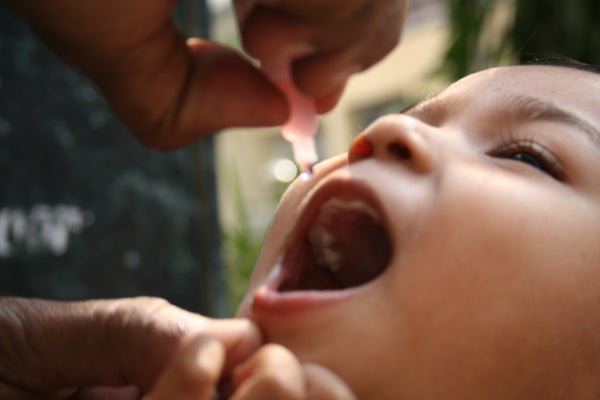
NEW DELHI (Thomson Reuters Foundation) - India plans to urgently immunize around 300,000 children against the crippling polio virus after a strain of the highly contagious disease was detected in sewage in the southern city of Hyderabad, the ministry of health said on Wednesday.
India was declared polio free by the World Health Organization in March 2014 after an almost two-decade long, multi-million dollar effort -- lauded as one of the country's biggest public health achievements in recent times.
On supporting science journalism
If you're enjoying this article, consider supporting our award-winning journalism by subscribing. By purchasing a subscription you are helping to ensure the future of impactful stories about the discoveries and ideas shaping our world today.
A health ministry statement confirmed media reports that a strain of the virus was discovered in a sewage sample taken near Hyderabad's Secunderabad railway station, but said that no children in area were found to be affected.
"India continues to be polio free as the country has eradicated wild polio virus and the last case was seen on 13th January, 2011, and it is more than five years that no wild polio virus has been detected," the health ministry said.
The statement said a recent survey of the area found 94 percent of children had received at least three doses of the oral polio vaccine and therefore transmission was unlikely.
However "as a precautionary measure" a special immunization drive would be held from June 20 in the high-risk districts of Hyderabad and Rangareddy, targeting around 300,000 children between the ages of six weeks and three years, it said.
Vaccination booths will be set up, the ministry said, and parents encouraged to get their children injected with the Inactivated Polio Vaccine which will provide additional protection against all types of polio.
Afghanistan and Pakistan are the only countries left in the world where the virus remains endemic.
The polio virus attacks the nervous system and can cause irreversible paralysis within hours of infection. It often spreads in areas with poor sanitation, and children under five are the most vulnerable.
India - where more than 50,000 children were once afflicted with the virus every year - was considered one of the toughest places in the world to eradicate polio.
Millions of health workers were involved in India's mammoth drive to immunize children by giving them polio drops. They targeted migrant families at bus stations, on trains and at festivals. Some used motorcycles or trekked to reach villages.
As a result, over 170 million children are now immunized every year, with millions more targeted in house-to-house visits in a drive costing more than $3 billion since 1995.
The health ministry said this is not the first time a strain of the virus has been detected in sewage samples, noting that 14 samples collected between January 2015 and May 2016 tested positive for a strain of the polio virus.
It said vaccination campaigns were initiated and that no children had been affected.
The ministry said India remained vigilant to outbreaks of polio and maintained "a highly sensitive surveillance system".