
On supporting science journalism
If you're enjoying this article, consider supporting our award-winning journalism by subscribing. By purchasing a subscription you are helping to ensure the future of impactful stories about the discoveries and ideas shaping our world today.
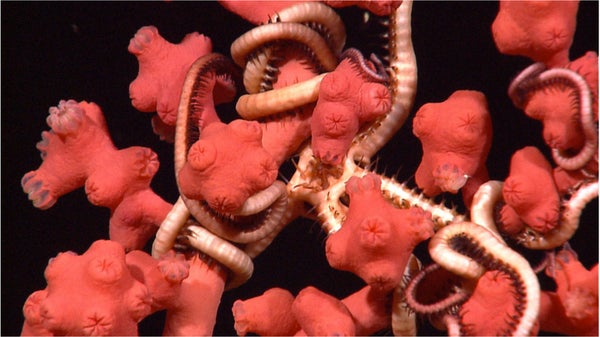
SAN FRANCISCO—A joint Indonesian–U.S. expedition in the Sulawesi Sea mapped at least 25 different types of undersea habitats and may have discovered dozens of new species, scientists announced here December 13 at the American Geophysical Union meeting. Among the candidates for new species, which were photographed this summer using a remotely operated vehicle (ROV), was this bubblegum coral, seen here with a brittle star wrapped around it.
Bubblegum corals are colonies of polyps that live in complete darkness at great depths, feeding on organic particles that fall from above, says Santiago Herrera, a graduate student at the Massachusetts Institute of Technology and the Woods Hole Oceanographic Institution. The coral seen here was a treelike colony about one meter tall and lived at a depth of approximately 1,000 meters, says Herrera, who was the coral expert on board the Okeanos Explorer, a research ship of the National Oceanic and Atmospheric Administration. Under his watch, the ROV spotted at least 40 species of coral that may be new to science, Herrera adds—although positively identifying new species will require getting actual samples to a lab.
The Sulawesi is in the transition area between the Pacific and Indian Oceans, which may explain its diversity—the researchers at the meeting say it is the underwater equivalent of the Amazon. Among the ecosystems explored, at depths between 800 and 4,000 meters, were hydrothermal vents near the 3,800-meter Kawio Barat undersea volcano, which is taller than Mount Saint Helens.
—Davide Castelvecchi