
Complex organic molecules have been discovered for the first time coming from the depths of Saturn’s moon Enceladus, a new study reported.
Spacecraft scheduled to launch soon could explore what this new discovery says about the chances of life within icy moons like Enceladus, the study’s researchers said.
The sixth largest of Saturn’s moons, Enceladus is only about 314 miles (505 kilometers) in diameter. This makes the moon small enough to fit inside the borders of Arizona.
On supporting science journalism
If you're enjoying this article, consider supporting our award-winning journalism by subscribing. By purchasing a subscription you are helping to ensure the future of impactful stories about the discoveries and ideas shaping our world today.
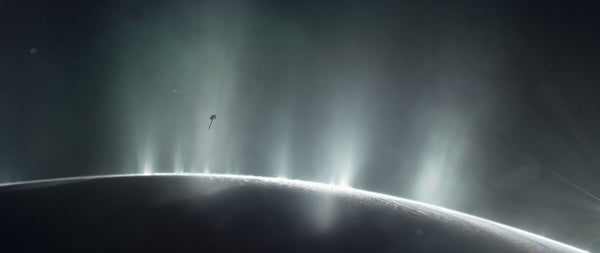
In 2005, NASA’s Cassini spacecraft detected plumes of water vapor and icy particles erupting from Enceladus, revealing the existence of a giant ocean hidden under the moon’s frozen shell. Because there is life virtually wherever there is water on Earth, these findings suggested that life might also exist on Enceladus.
Previously, scientists had detected only simple organic (carbon-based) compounds, each less than about five carbon atoms in size, in the plumes of Enceladus. Now, researchers have detected complex organic molecules from the moon, including some at least 15 carbon atoms in size.
“This is the first-ever detection of complex organics coming from an extraterrestrial water world,” study lead author Frank Postberg, a planetary scientist at the University of Heidelberg in Germany, told Space.com.
The scientists analyzed data that Cassini gathered when it flew within a plume from Enceladus, as well as from when the probe passed through Saturn’s E ring, which is made up of ice grains spewed from Enceladus. The investigators detected ice grains loaded with complex organic material in both the plume and the E ring.
The researchers conjectured that these organic materials were cooked up inside the hot, rocky and fragmented core of Enceladus, which prior work suggested had water seeping through its pores.
“The organics are then injected, together with the hot water, into the overlying cooler ocean by hydrothermal vents,” Postberg said. “Then, they can be transported upwards to the ocean surface on the walls of rising bubbles of gas."
Postberg noted that most of the organic-loaded ice grains the researchers saw were in Saturn’s E ring. This might suggest that these complex organic molecules were not produced within Enceladus, but instead resulted from sunlight-triggered chemical reactions in space.
“However, we observe the highest proportion of these complex organics in the young, inner E ring close to Enceladus, as compared to the old, outer E ring far away from Enceladus,” Postberg said. “Furthermore, we also see the complex organics directly in the plume.”
The researchers cautioned that these new findings are not solid evidence for life, as biological reactions are not the only potential sources of complex organic molecules. The next logical step is to go back to Enceladus soon "and see if there is extraterrestrial life,” Postberg said. “Nowhere else can a potentially habitable extraterrestrial ocean habitat be so easily probed by a space mission as in the case of Enceladus.”
Postberg added that the European Space Agency already has missions, Europa Clipper and JUICE, scheduled to launch in 2022 that will visit Europa and Ganymede, the icy moons of Jupiter that have subsurface oceans. These missions will check for habitability on those worlds.
The scientists detailed their findings online June 27 in the journal Nature.
Copyright 2018 SPACE.com, a Purch company. All rights reserved. This material may not be published, broadcast, rewritten or redistributed.