
Neurons talk to one another using electricity. If you could hear these impulses, they might sound like constant, rapid-fire chatter all over the nervous system. Heart muscle cells do something similar, issuing electrical “heave-ho” signals that make the organ beat.
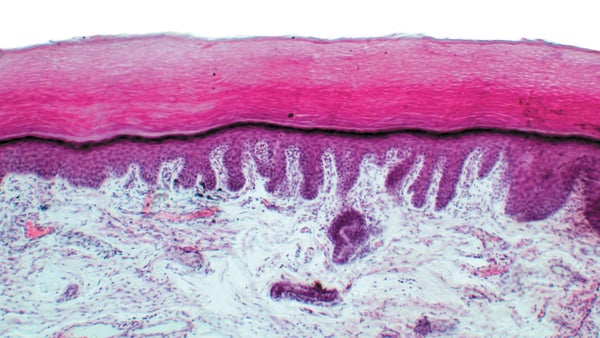
Skin and other epithelial cells, however, were thought to be silent; they form barrier tissues that protect the body’s interior from the outside world, and they weren’t assumed to need this kind of communication. So researchers were amazed to discover recently that, when wounded, these cells emit a slow electric pulse in a way that resembles neuron firing.
“The epithelial cells are making a signal kind of like a scream: ‘We got injured, we need repair, you need to come over here,’” says Sun-Min Yu, an engineer at the University of Massachusetts Amherst and lead author of the study, published in the Proceedings of the National Academy of Sciences USA. The signal may summon other cells to help rebuild the damaged spots.
On supporting science journalism
If you're enjoying this article, consider supporting our award-winning journalism by subscribing. By purchasing a subscription you are helping to ensure the future of impactful stories about the discoveries and ideas shaping our world today.
Epithelial cells form the skin’s outer layer and line the gut, blood vessels, airways—basically “every single organ in your body that connects to the outside world,” says Ellen Foxman, who wasn’t involved in the new findings but studies epithelial cells at the Yale School of Medicine. When injured, these cells were known to coordinate healing by passing chemical signals to their neighbors. But Yu says she “thought maybe there should be a faster signaling pathway.” She cultured epithelial skin cells from humans and kidney cells from dogs in dishes fitted with an array of electrodes. When she used a laser to wound the cells, she detected some electrical “noise” coming from locations near the lesions.
“It was a very evident, active signal” that strongly resembled a neuron’s self-generated electrical spikes, Yu says. These bursts were faster than chemical messengers but much slower than neurons’ signals; they lasted seconds instead of milliseconds and rippled across at least a dozen other epithelial cells. It is unclear how the epithelial cells produced the signals, but the researchers found that these cells could fire only in the presence of calcium ions. Neuron signaling is also known to rely on ions, including calcium, sodium and potassium; the ions’ electrical charge provides the signature voltage spike.
The new observations “show that maybe there’s longer-range communication” among epithelial cells to coordinate healing, Foxman says. Understanding exactly how these cells respond to damage could reveal why the process sometimes goes wrong. “When you get a cut, sometimes it heals perfectly,” she says, but other times the process leaves a scar—and scars on an internal organ’s epithelium can sometimes lead to chronic health conditions. “That’s what I’m excited about,” Foxman adds. “Whenever you find a new pathway, you could study and potentially use [it] to develop a new treatment.”
It’s still not certain what role this signaling plays in living organisms or what other cells do when they receive a signal, says Sarah Najjar, who studies gut epithelial cells at New York University. “What is downstream of this electrical activity?” she wonders. Does it influence neurons? Yu next plans to study whether these two types of cells interact. “I want to know how the high-pitched signals [of neurons] are translated” for epithelial cells tuned to lower-pitch signals, and vice versa, she says. “It’s a study coming from our curiosity.”