

It’s 2039, and NASA’s Artemis XVIII mission is landing on the moon. Rockets blazing, a silver tower smoothly descends to a brightly lit landing pad on the lunar surface. After a flawless landing, astronauts emerge, with white space suits begrimed in moments by the hanging moon dust. They disembark to the surface and hop over a protective berm of piled rocks to arrive at a waiting buggy.
That’s the plan, at least, according to NASA’s acting associate administrator Greg Stover, who laid out the vision at an April meeting at the Johns Hopkins University Applied Physics Laboratory (APL) in Maryland. Fresh off the unbelievably successful Artemis II lunar flyby mission, NASA is gearing up for an ambitious slate of moon trips to establish a colony by 2036. It will culminate in landings such as Stover’s imagined “Artemis XVIII” mission.
“There’s a lot that we got to think through ... to be on that Artemis XVIII mission,” Stover said. “When we talk about living and working on the moon, it’s not just a single mission. It’s an ecosystem.”
On supporting science journalism
If you're enjoying this article, consider supporting our award-winning journalism by subscribing. By purchasing a subscription you are helping to ensure the future of impactful stories about the discoveries and ideas shaping our world today.
The plan stems in part from a December 18, 2025, Trump administration executive order that told NASA to turn its exploration focus to the moon. According to this order, the space agency’s priorities should include landing people on the moon by 2028 and starting a permanent lunar outpost by 2030. These orders were reiterated by NASA’s recently confirmed administrator Jared Isaacman at an “Ignition” event at NASA Headquarters in March in which the agency announced its moon base program. Isaacman told dozens of international partners and space industry figures there that NASA was ready to jump-start its slow-going exploration of the moon and Mars. Previous schemes had gone nowhere since the end of the space shuttle era, he said, with “billions of dollars wasted, years lost, nonconforming hardware delivered, programs that never launch, fewer flagship science missions, virtually no X-planes and fewer astronauts in space.”
To speed things up, NASA is turning to the growing private space industry to fulfill a three-part moon base plan. First, it aims to land astronauts on the moon by 2028. Next, it will build a base at the lunar south pole and begin bringing astronauts there every six months by 2032. Finally, the agency will establish a nuclear-powered permanent outpost by 2036. This $30-billion, 11-year plan calls for 79 launches, 73 landers, 10 moon buggies, 12 “hopper” rocket drones, four habitat modules and numerous other pieces of infrastructure, including a 20-kilowatt nuclear reactor.
“It is very ambitious. We are doing that deliberately,” says Carlos Garcia-Galan, NASA’s moon base “viceroy,” as Isaacman put it at the March event. “We want to understand what [are] the things that prevent” a moon base, Garcia-Galan adds. After Isaacman asked for a more detailed plan, agency scientists brought together varied components of long-running moon exploration plans and parts that were already built for those missions to develop the Ignition proposal.
The next small step for the moon comes with SpaceX’s planned mid- to late May launch of a stretched version of its gigantic Starship rocket. The new rocket’s upper stage would notionally serve as the basis for a lunar lander. The test flight aims to reach low-Earth orbit for the first time. Later this year Blue Origin will make its first attempt at landing a rover, NASA’s Volatiles Investigating Polar Exploration Rover (VIPER), on the lunar south pole—the planned setting for the moon base.
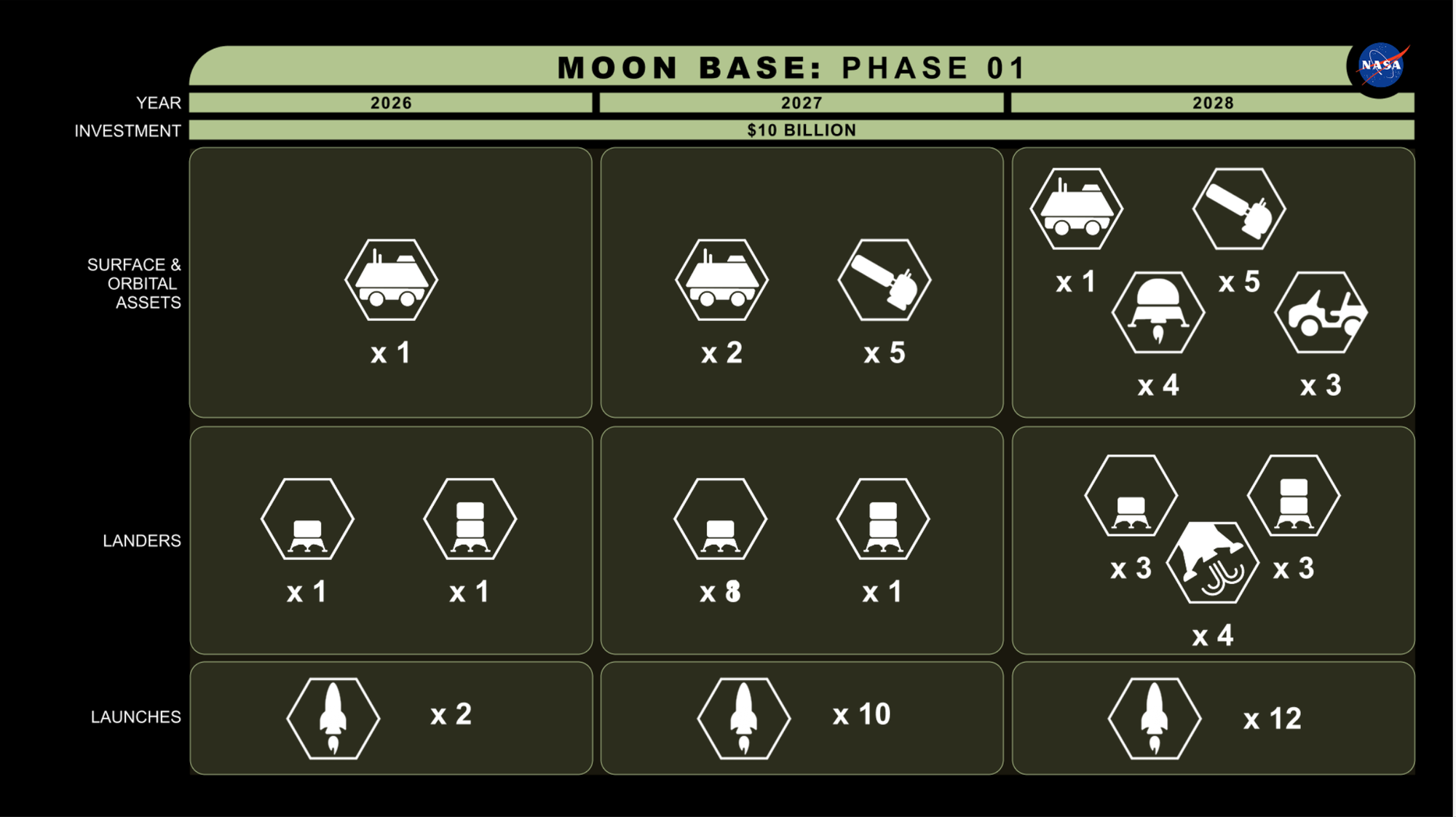
The first $10-billion phase of NASA’s moon base plan.
NASA
Volatiles
Celestial geometry and past calamity lie behind this lunar south pole target. Some 4.33 billion years ago a 162-mile-wide meteorite with an iron core travelling at about 29,000 miles per hour plowed into the far side of the moon’s southern hemisphere, according to a May 6 Science Advances report. The impact left behind a tapered impact crater basin that, at some 1,600 miles wide and five miles deep, is one of the largest in the solar system. Pulverized, the iron core likely caromed off the moon after initially digging deep into the lunar mantle and scattering traces of magnetized terrain across the south pole. Smaller craters now dot this basin and the rough polar terrain beyond it and are covered with samples of the moon’s mantle from that long-ago blast, if the study’s calculated trajectory is correct.
More geometry ensures that the lunar south pole only sees sunlight that travels nearly parallel to its curved surface. As a result, even small crater rims cast long shadows. Circling Earth on a slight 5.1-degree tilt with respect to its orbit of the sun, the moon’s poles endure odd, inconstant illumination in which they are dark for months and weeks. Some crater rims stand tall enough to receive unending sunlight, and others endure eternal darkness in their depths, with temperatures well below –328 degrees Fahrenheit. These permanently shadowed “cold traps” are the places where explorers hope to find water ice left over from comet impacts and other useful ingredients to help sustain a moon base.
On May 4 Ireland became the 66th nation to sign NASA’s Artemis Accords, which call for the peaceful, cooperative human exploration of the moon and Mars, as outlined by the 1967 Outer Space Treaty. The accords allow for “utilization of space resources” such as that purported lunar water. That language in the agreement has raised concerns about a land rush for the lunar south pole’s riches, says astronomer Aaron Boley, co-director of the Outer Space Institute at the University of British Columbia. The geopolitics involved in the push for a moon base, which U.S. lawmakers have called a “race” with China’s burgeoning space program, have raised worries over keeping the lunar south pole pristine for science. “You have this truly special place that has a record of the early Earth tied to it, and you really get only one shot at [exploring] it,” Boley says. “If you screw it up, you really screwed it up.”
NASA’s Garcia-Galan agrees that disturbing the moon’s record of solar system science is a concern. “We don’t want to ruin a landing area that has a ton of scientific value,” he says.
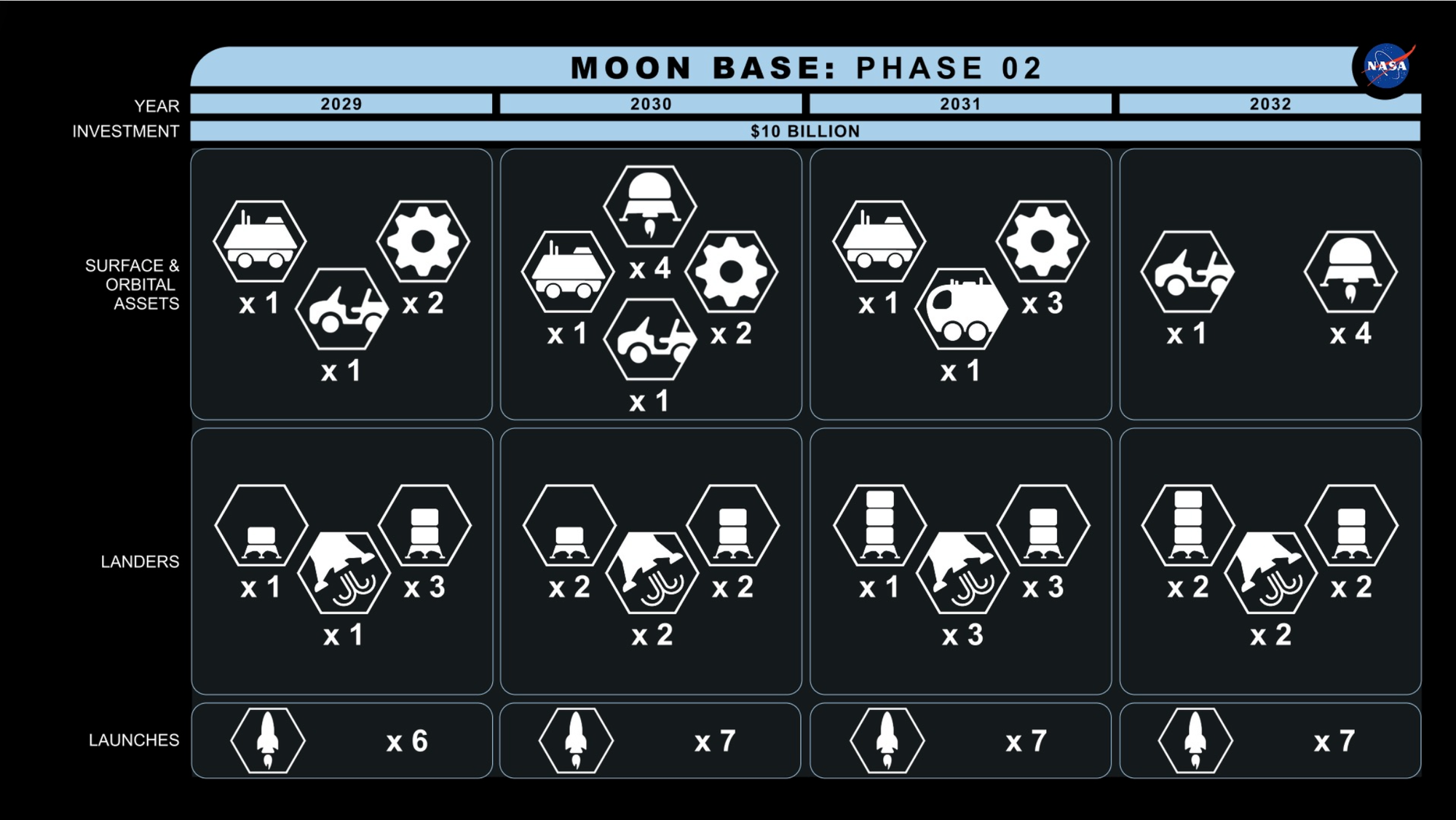
A NASA schematic of the second phase of the moon base plan.
NASA
Cadence
Landing on the moon isn’t easy, as Neil Armstrong’s dicey touchdown during Apollo 11 famously demonstrated on July 20, 1969. Lunar regolith, a loose agglomeration of volcanic ash, grit, stones and boulders, covers the moon to depths of perhaps 65 feet, topped by a thin layer of gritty, sharp volcanic dust. The heavily cratered “highland” terrain of the lunar south pole partly explains why the six Apollo landing missions from 1969 to 1972 instead targeted smoother lunar “mare” regions and heavily worn craters, landing sites that provided less challenging conditions. (Closer to the moon’s equator, the latter areas also required spacecraft to brake less to put themselves on a landing path.) Intentional crash landings aside, only half of the uncrewed lunar landings attempted in the 21st century have succeeded. These include China’s successful rover missions and Intuitive Machines’ 2024 IM-1 mission, which broke a leg on landing.
NASA doesn’t even have a usable lander yet. Its plan pits SpaceX and Blue Origin against each other to deliver working landers next year for a test of docking and operations in Earth orbit on the Artemis III mission. The SpaceX contender is a lunar lander version of its Starship upper-stage rocket, which has yet to reach Earth orbit. The Blue Origin entry is an upgraded version of its Mark I lunar lander, which is scheduled to deliver a science rover on the lunar south pole later this year. “Whichever lander is ready to go, we’ll go with,” says Lori Glaze, acting associate administrator for NASA’s Exploration Systems Development Mission Directorate. Both landers would likely need to refuel in Earth orbit before they would carry astronauts to the south pole—an arrangement that would require undeveloped technology—although Glaze says that the space agency might hear plans that would involve less refueling from the companies.
One part of the accelerated moon base plan is to reuse modules that were already built by NASA for the now canceled moon-orbiting Gateway space station, Garcia-Galan says. Gateway was proposed during the first Trump administration, but it was discarded by the Ignition plan. Later in April, however, Isaacman confirmed at a congressional hearing that the aluminum shells of the only two habitable Gateway modules that had been delivered to NASA so far (both of which were built by Europe’s Thales Alenia Space) were corroded. The problem would have likely pushed the launch of Gateway past 2030 if it hadn’t been called off, he told lawmakers.
Corrosion is already a big worry on the moon, largely because of its volcanic dust. “The fact is it’s a very low-gravity environment, which means the dust kicked up tends to stay there,” says robotics engineer Kenneth Stafford of the Worcester Polytechnic Institute. “There are no breezes. There’s no air, so [the] dust doesn’t blow away; it just hangs there like a fog.” The electrostatically charged dust will get into anything, including sensors, bearings and space suits. Such dust famously caused eye irritation for Apollo astronauts because of its sharp, unweathered edges. As for steering a buggy to the Artemis base, compasses don’t work on the moon, and dust will adhere to optics, so NASA has pioneered plans to use Earth’s Galileo and GPS satellites to navigate. Earthly lubricants won’t withstand the moon’s vacuum, which additionally serves as insulation preventing the release of excess heat from machinery. A lot of the infrastructure for a lunar outpost, down to cables rated as lunar-radiation-resistant to transmit power from the proposed nuclear reactor, aren’t yet available, speakers noted at the APL lunar surface conference in April. Just getting two modules to line up on the uneven lunar surface will be a challenge, Garcia-Galan says.
The moon’s low gravity—one sixth of Earth’s—makes it difficult for rovers to gain traction to move rocks around to build the berms envisioned to surround those landing pads and habitats or to uncover the minerals sought by astronauts. You can’t just ship a heavy bulldozer to the moon and fire it up, Stafford says. Rovers that scoop rocks on both ends seem to have better traction. Packing down a landing pad sounds easier to him than building berms because the regolith readily compresses, at least in simulations. The Ignition plan, however, now calls for both SpaceX and Blue Origin to demonstrate a successful uncrewed landing of their astronaut landers next year, when prepared landing pads seem unlikely. That’s a worry after the IM-1 spacecraft snapped a leg on landing in 2024 and after a Japanese lander crashed during touchdown in 2025.
In the past two decades, NASA’s engineers have designed rovers that can steer up steep slopes with less traction and drive over boulders. The Ignition plan calls for simpler rovers that can do jobs for a short while before expiring rather than lasting for decades. “All engineering is a trade-off,” Stafford says. “NASA has had a tendency in the past to default in the wrong direction of trying to literally gold-plate some things, where something simpler and easier to build is probably going to do the job.”
The biggest challenge will be getting all this stuff to the moon in a timely way—in other words, mastering the “cadence,” says Garcia-Galan, the moon base viceroy. “The number of assets, launches and landers that we need to accomplish this, I think we need to focus on that.”
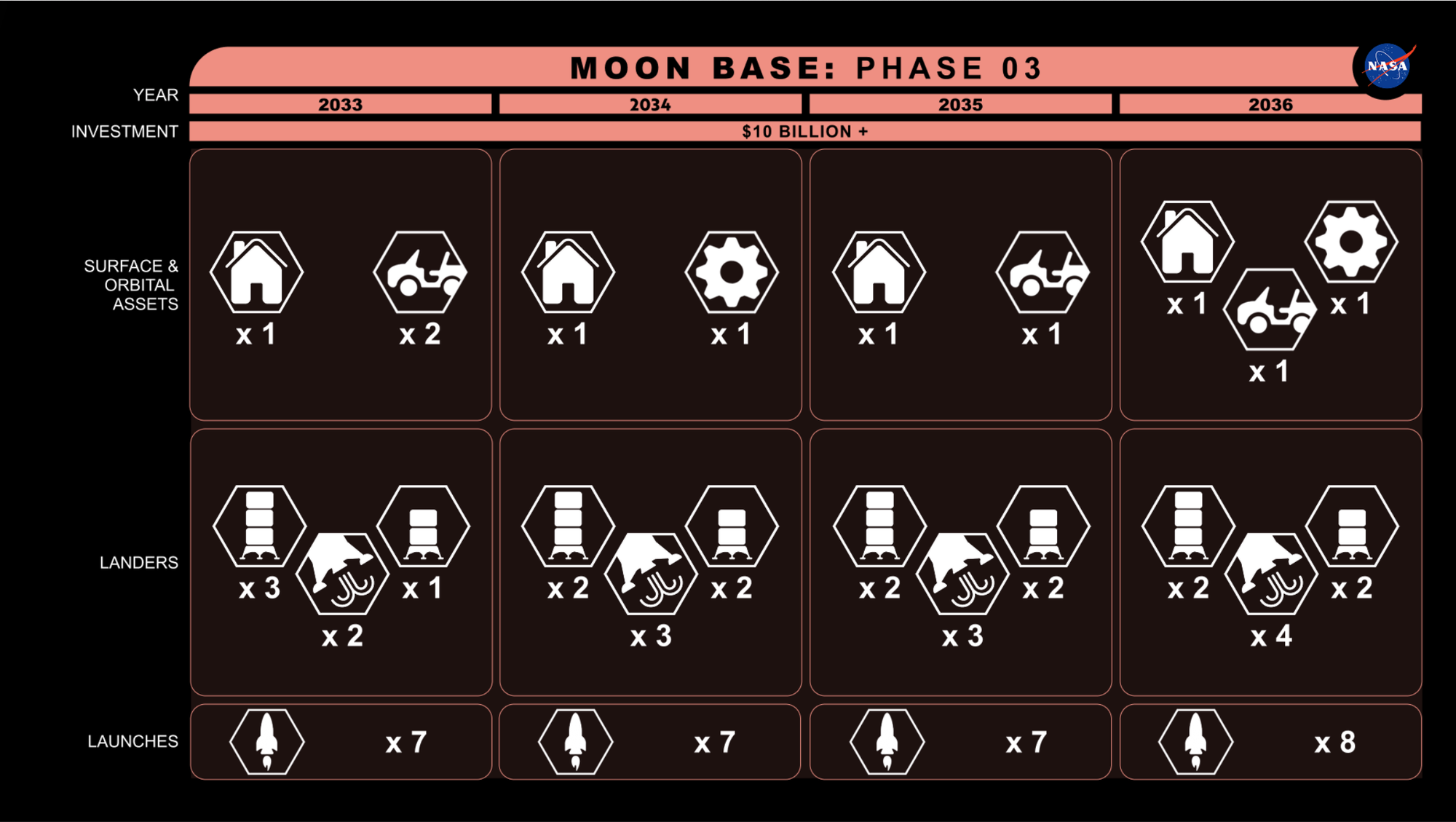
A NASA schematic of the final phase of its moon base plan.
NASA
Lewis and Clark
Space policy experts express a fair amount of skepticism about NASA meeting its 2028 moon landing target date, even with the new plan. “Artemis, when it was originally proposed, was supposed to land humans in 2024. And here it is now, [and] we’re talking 2028,” says Wendy Whitman Cobb, a professor of strategy and security studies at the School of Advanced Air and Space Studies (SAASS) at Maxwell Air Force Base, who notes that she is speaking only for herself. “I think it’s possible. But there’s a big if there, and that is the commercial companies and the availability of a landing system.” The tight timeline puts a lot of pressure on the Artemis III lander testing mission, as well as the uncrewed tests proposed for SpaceX and Blue Origin, with funding for the latter coming out of the companies’ own pockets. The development of lunar space suits—a job NASA gave to the private firm Axiom Space—is also behind schedule, according to the agency’s inspector general. “There are a lot of ifs in there,” Cobb says. “And there is never enough time.”
The Ignition plan does at least simplify the envisioned moon base by killing Gateway and a costly, proposed upper-stage booster for the agency’s jumbo-size, long overbudget Space Launch System rocket. But whether that simplification buys private space firms enough time and fuel savings to deliver the landings in 2028 is something NASA will find out in coming months as the companies respond to its proposal. “The way I think of it is: The administrator laid out the broad vision of what we want to achieve, our goals at the moon,” Glaze says. The Ignition plan “truly is market research. We want to get the data back.”
Rather than being the final word, NASA’s plan might just be the opening bid for humanity’s return to the moon, says engineering professor John Horack, who holds the Neil Armstrong Chair in Aerospace Policy at the Ohio State University. He compares the Ignition plan to explorers Meriwether Lewis and William Clark’s initial 1803 plan for the Corps of Discovery to chart the U.S. West. The expedition adapted to new conditions, higher mountains and rougher waters while looking for a route to the Pacific Ocean. “It’s the beginning of a journey,” Horack says. “If I had to guarantee you something, I guess I would guarantee you that this [plan] is not exactly how it’s going to go.”
In one encouraging sign, financiers are looking on lunar space firms with more enthusiasm, says Raphael Roettgen, founding partner of E2MC Ventures, a space-focused venture capital firm. A variety of firms, including older, more staid ones that do mining on Earth, for example, are expressing interest in lunar resources. And the success of the Artemis Accords makes it look like there will be rules for space exploration. “People need a sustained economic reason to go there,” Roettgen says. The geopolitical factors behind some of the interest in the lunar south pole makes things seem more inevitable. “I’m pretty sure that the U.S. and its allies are very unlikely to leave the entire base to China,” he says.