
Gravitational waves—ripples in spacetime produced by merging black holes, colliding neutron stars, detonating supernovae and other cosmic cataclysms—have sparked a revolution in astrophysics. First observed in 2015, a century after Albert Einstein predicted their existence, these elusive whispers in the fabric of reality are already revealing otherwise hidden details of the exotic objects that produce them. Studies of gravitational waves have provided researchers with the first direct evidence that black holes exist, produced new estimates of the cosmic expansion rate, and shown that neutron stars are the main sources of the universe's supply of gold, platinum and other heavy elements. Eventually they could allow researchers to glimpse the universe as it was in the first fractions of a second after the big bang.
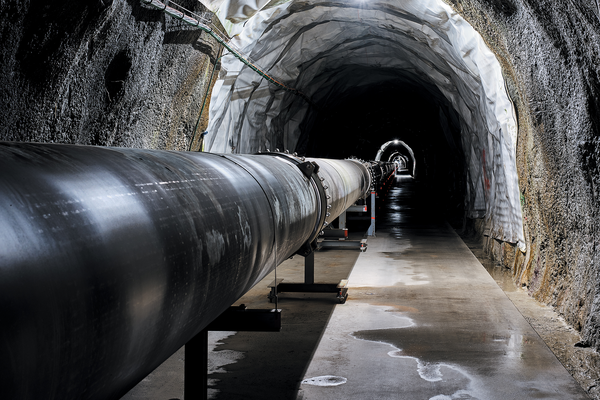
The forefront of this promising future can be found in a subterranean complex of darkened tunnels. There more than 200 meters below Mount Ikenoyama in the Gifu prefecture of central Japan, an international team of scientists, engineers and technicians is finishing almost a decade of steady construction, readying the Kamioka Gravitational-Wave Detector (KAGRA) to begin operations by the end of this year. Soon KAGRA will join the world's three other active gravitational-wave detectors—the twin stations of the U.S.-based Advanced Laser Interferometer Gravitational-Wave Observatory (LIGO) in Hanford, Wash., and in Livingston, La., and the Advanced Virgo facility near Pisa, Italy. KAGRA's location in Japan and orientation with respect to LIGO and Virgo will independently check and enhance those detectors' observations, allowing researchers to better measure the orientations and spins of merging black holes and neutron stars.

SHIELDING VIBRATIONS (left):
A technician squats beside the uppermost section of a 14-meter-tall vibration isolation system for one of KAGRA's polished sapphire mirrors. Such systems are necessary shields against outside noises, allowing a passing gravitational wave's minuscule signature—a mirror's shift by a fraction of a thousandth of the width of a proton—to be detected.
MIRROR, MIRROR (right):
A view of the delicate apparatus that keeps a mirror in place, before installation in KAGRA's cryogenic system. The sapphire mirror is held in the cylindrical chamber in the bottommost stage, suspended by four thin sapphire fibers. The remaining three vertical stages contain components to isolate the mirror assembly from seismic noise and are fabricated with a variety of materials that can withstand KAGRA's extremely cold operating conditions.
Credit: Enrico Sacchetti (left); Institute for Cosmic Ray Research, University of Tokyo (right)
On supporting science journalism
If you're enjoying this article, consider supporting our award-winning journalism by subscribing. By purchasing a subscription you are helping to ensure the future of impactful stories about the discoveries and ideas shaping our world today.
Collectively, this quartet of detectors will reach new heights of sensitivity and precision, finding fainter gravitational-wave events than ever before and pinpointing their celestial coordinates with unprecedented acuity for follow-up with conventional telescopes. Here selected photographs capture some of the final technical preparations before KAGRA is unleashed on the sky.
To find gravitational waves, KAGRA relies on the same method used by LIGO and Virgo, a technique called laser interferometry. In this approach, a laser beam bounces between mirrors suspended at the ends of two pipelike vacuum chambers. The chambers are several kilometers long and oriented perpendicularly to each other, forming what looks like a giant L. The laser acts as a measuring stick, revealing when a passing gravitational wave briefly stretches and shrinks spacetime, altering the chambers' lengths (and thus the total distance a beam of light travels). Such perturbations are inconceivably tiny, far smaller than the diameter of a single proton—meaning that each facility must somehow account for or suppress an almost countless assortment of contaminating noises, from the enormous seismic motions of earthquakes and tides to the softer vibrations caused by airplanes overhead, passing cars, nearby wildlife or even a mirror's jiggling atoms. Distinguishing between legitimate gravitational-wave signals and noise-induced “glitches” is an almost overwhelming task—and one that has contributed to numerous false alarms mixed in with the dozens of authentic detections collaboratively announced to date by LIGO and Virgo.

TIGHT BEAM (left):
To ensure that KAGRA's lasers can accurately register the almost imperceptible distortions of its mirrors caused by gravitational waves, scientists must precisely control the location and brightness of the laser beam. This requires feeding the laser through what is effectively a telescope (shown here) mated to another vibration isolation device and housed inside a vacuum vessel.
KEEPING COOL (right):
A technician checks a mirror's suspension system before its installation inside KAGRA's cryogenic containers. Once inside, the mirror and its mounting are cooled to almost absolute zero—all in an effort to minimize the thermal vibrations of their constituent atoms, allowing signatures of fainter gravitational waves to be seen.
Credit: Enrico Sacchetti (left); Rohan Mehra (right)
Buried deep below its mountain, KAGRA will be the first major laser interferometer built and operated entirely underground, far from the cacophony of background noise at the terrestrial surface. It is also the first to use cryogenically cooled mirrors—each a polished 23-kilogram cylinder of sapphire crystal—which can dramatically reduce thermal vibrations and deliver corresponding boosts in sensitivity. LIGO's and Virgo's mirrors are kept at room temperature; KAGRA's will be maintained at a frigid 20 degrees above absolute zero.
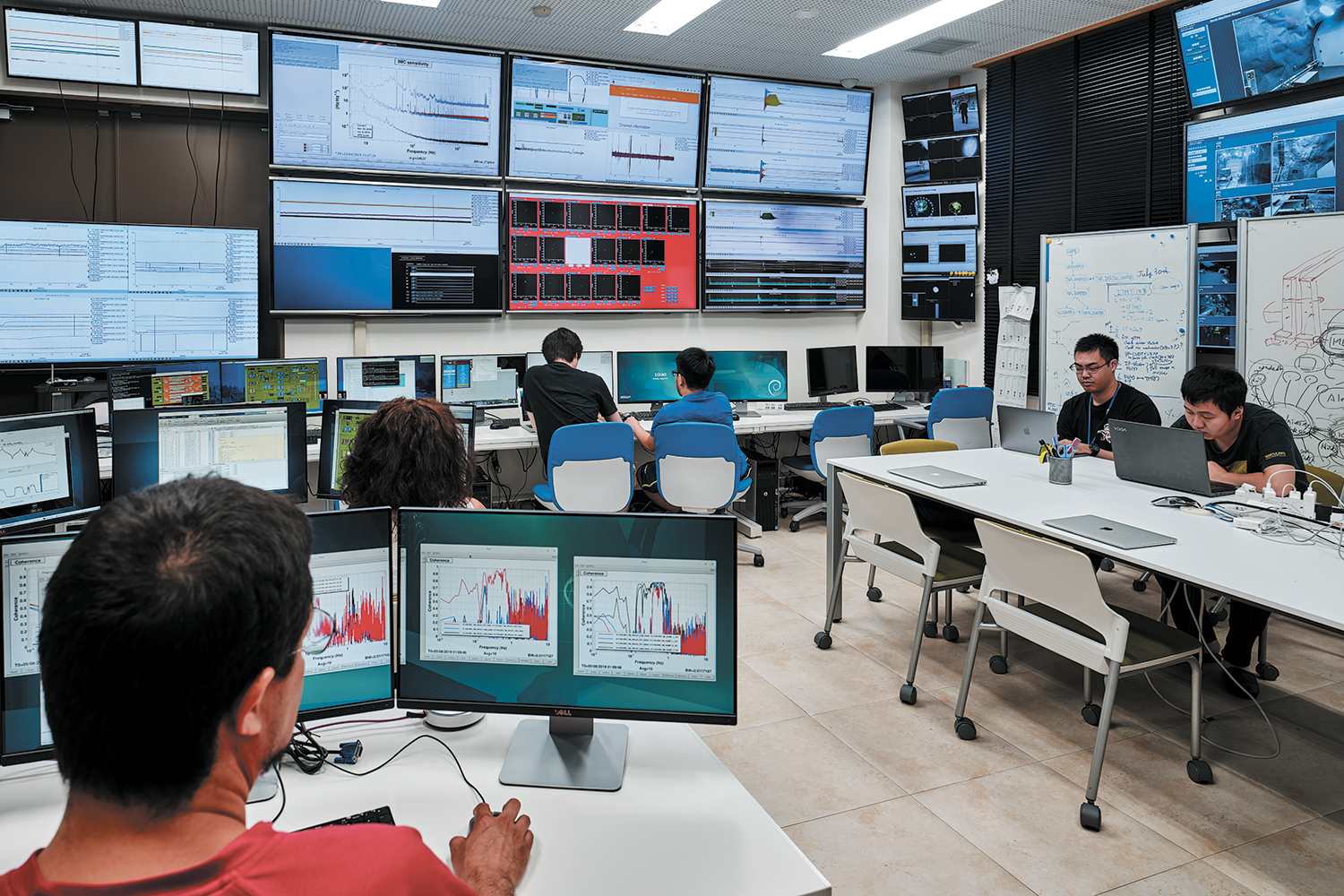
COMMAND CENTER:
All of KAGRA's instruments are controlled from this room at the surface, a 10-minute drive from the underground cavern's entrance. A wall-mounted bank of six large screens displays the temperature, humidity and operational conditions of the KAGRA site, and smaller screens along the room's right wall show snapshots of laser light cascading through the vacuum tunnels, as well as information about seismic activity throughout Japan.
Credit: Enrico Sacchetti
Although these two advances could in principle allow KAGRA to find fainter sources of gravitational waves than LIGO or Virgo, they are not without drawbacks: Mechanical coolers keep the laser-bathed mirrors cold but also introduce their own vibrational noise into measurements, and water from rain and melting snow regularly infiltrates KAGRA's tunnels, forcing workers to install plastic sheets to protect delicate equipment. Even with protection, the moisture may halt operations during the wettest times of year.
If all goes according to plan, KAGRA will not only help make additional major discoveries but also demonstrate the new technologies likely to be used by the next generation of more advanced gravitational-wave observatories around the globe.