
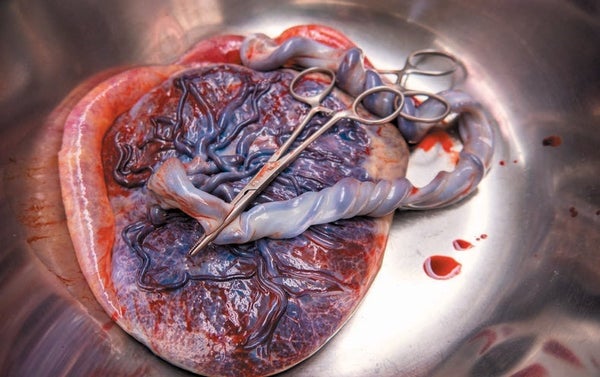
To obtain nutrients for a growing fetus, a placenta embeds itself into the uterus—an “invasion” that resembles the way a tumor takes over healthy tissue. Now researchers have identified genes that help to regulate placental embedding and may prove instructive in developing anticancer drugs, according to a new study in the Proceedings of the National Academy of Sciences USA.
Scientists knew that the amount a placenta embeds varies across species. In some, such as humans and apes, placenta cells push deep into the uterine wall with relative ease. But in animals like cows and horses, the uterus has evolved to resist such intrusions more strongly. This capability may help protect the maternal immune system and lessen uterus damage when giving birth.
In 2019 cellular biologists Günter Wagner of Yale University and Kshitiz of the University of Connecticut Health found that this cellular resistance extends beyond the uterus. They observed a direct correlation between how deeply a species' placenta embedded and the rate of tumors that spread beyond their primary site in that species' body. Species with highly embedded placentas were associated with higher rates of metastatic cancer; cellular material connecting tissues and organs in these species was less resistant to invasion by both placentas and tumors. The question was why.
On supporting science journalism
If you're enjoying this article, consider supporting our award-winning journalism by subscribing. By purchasing a subscription you are helping to ensure the future of impactful stories about the discoveries and ideas shaping our world today.
For the new study, Kshitiz, Wagner and their colleagues examined nine mammal species for differences in protein production that might explain how some species' tissues resist invasion more strongly. The team identified two proteins that, when produced in abundance, made tissues more susceptible to cellular intrusion—whether from a placenta or a tumor. When the protein-producing genes were removed, cells blocked invasion more effectively.
“A mutation that helps the uterus keep the placenta out also [could affect] the biology of cancer in, say, the skin,” Wagner says.
To Wellcome Sanger Institute cancer biologist Sam Behjati, who was not involved in the study, this finding suggests new ways to target tumor growth and spread. “This is a hard-core, comparative biological study,” he says. Scientists know a lot about the molecular steps required for implantation—and “it would be nice to employ that line of pharmacological thinking for metastases.”
Still, Amy Boddy, a comparative oncologist at the University of California, Santa Barbara, who was also not involved, cautions that this specific invasion process probably does not tell the whole story. Cancers have a variety of causes and contributors. “Everything that is multicellular is vulnerable to cancer,” Boddy says. “We've just started probing the potential mechanisms.”