
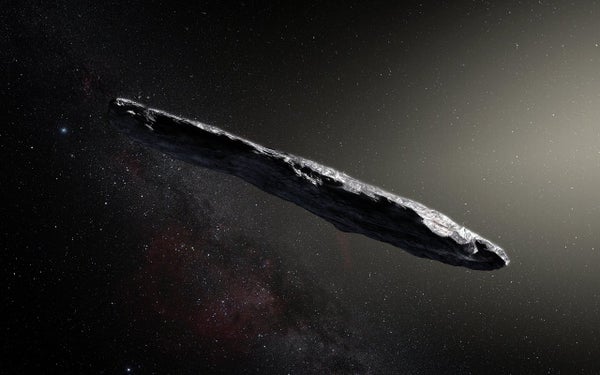
When astronomers using the Pan-STARRS1 telescope in Hawaii spotted a mysterious object dashing through our solar system on Oct. 19, they immediately knew it was something special.
Traveling at high speed and originating from interstellar space, this object was originally thought to be an ancient comet, but observations revealed it was, in fact, an asteroid from another star system.
"For decades we’ve theorized that such interstellar objects are out there, and now—for the first time—we have direct evidence they exist," Thomas Zurbuchen, associate administrator for NASA’s Science Mission Directorate at the agency's headquarters in Washington, D.C., said in a statement. [Solar System Explained from the Inside Out (Infographic)]
On supporting science journalism
If you're enjoying this article, consider supporting our award-winning journalism by subscribing. By purchasing a subscription you are helping to ensure the future of impactful stories about the discoveries and ideas shaping our world today.
"This history-making discovery is opening a new window to study formation of solar systems beyond our own," he added.
Astronomers have determined that the mysterious object—which has been named 'Oumuamua and given the official scientific designation 1I/2017 U1—looped around the sun on Sept. 9 and made its closest pass by Earth on Oct. 14. 'Oumuamua (whose name means "a messenger from afar arriving first" in Hawaiian) is now about 124 million miles (200 million kilometers) from Earth and is zooming away from us at about 85,700 mph (137,900 km/h) relative to the sun, NASA officials said.
Researchers scrambled to get some good looks of the interstellar interloper, which have revealed that this object is very special indeed. In fact, it's like nothing we’ve ever seen before.
"It's a really rare object," astronomer Ralf Kotulla, of the University of Wisconsin-Madison, said in a different statement.
With colleagues from UCLA and the National Optical Astronomy Observatory (NOAO), Kotulla's team captured some of the first images of U1 using the 11.5-foot (3.5 meters) WIYN Telescope on Kitt Peak in Arizona. These first images confirmed that the object doesn't have a coma—the cloud of dust and gas that fizzes from a comet as it approaches the sun—and is therefore an irregularly shaped asteroid.
Now, in a study published today (Nov. 20) in the journal Nature, astronomers using the European Southern Observatory's (ESO) Very Large Telescope (VLT) in Chile describe the strange characteristics of U1.
"This unusually large variation in brightness means that the object is highly elongated: about 10 times as long as it is wide, with a complex, convoluted shape," astronomer Karen Meech, of the Institute for Astronomy in Hawaii, said in another statement, this one put out by ESO. "We also found that it has a dark red color, similar to objects in the outer solar system, and confirmed that it is completely inert, without the faintest hint of dust around it."
'Oumuamua is thought to be at least 1,300 feet (400 m) long, rocky (with some metal perhaps mixed in), relatively dense and shaped like a cigar, researchers said. It likely acquired its ruddy hue after being bombarded by high-energy cosmic rays for the millions of years it's been drifting through interstellar space, team members added.
Using the NASA/European Space Agency Hubble Space Telescope and NASA's Spitzer space telescope, astronomers continue to study 'Oumuamua as it heads toward the outer solar system, in an attempt to learn more about this strange object.
"We are continuing to observe this unique object, and we hope to more accurately pin down where it came from and where it is going next on its tour of the galaxy," observation team member Olivier Hainaut, from ESO in Garching, Germany, said in the ESO statement. "And now that we have found the first interstellar rock, we are getting ready for the next ones!"
Astronomers estimate that such interstellar visitors shoot though the inner solar system about once a year, but only recently, with the incredibly powerful optics of telescopes like Pan-STARRS1, have they been able to detect these very faint objects.
EDITOR'S RECOMMENDATIONS
Copyright 2017 SPACE.com, a Purch company. All rights reserved. This material may not be published, broadcast, rewritten or redistributed.