
The first interstellar asteroid ever discovered in our solar system remains silent, at least for now.
An initial search for artificial signals coming from 'Oumuamua, the needle-shaped interloper that zoomed past Earth two months ago, have come up empty, scientists with the $100 million Breakthrough Listen project announced today (Dec. 14).
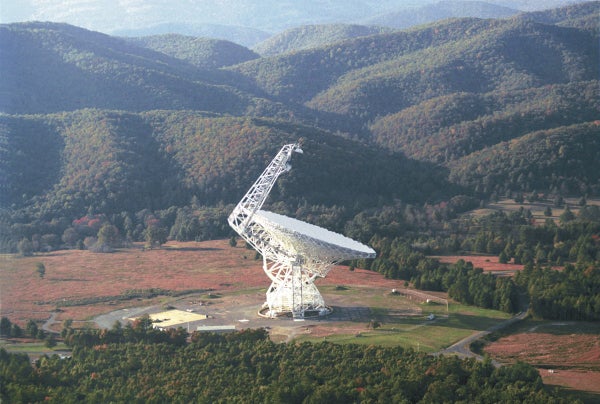
But researchers aren't done analyzing the data that came in from the Robert C. Byrd Green Bank Telescope in West Virginia yesterday (Dec. 13), and they also plan to conduct three more "blocks" of observations, team members said. ['Oumuamua: Our 1st Interstellar Visitor Explained in Photos]
On supporting science journalism
If you're enjoying this article, consider supporting our award-winning journalism by subscribing. By purchasing a subscription you are helping to ensure the future of impactful stories about the discoveries and ideas shaping our world today.
"It is great to see data pouring in from observations of this novel and interesting source," Andrew Siemion, director of the Berkeley SETI (Search for Extraterrestrial Intelligence) Research Center in California, said in a statement. "Our team is excited to see what additional observations and analyses will reveal."
'Oumuamua has caused quite a buzz in the astronomy, planetary-science and SETI communities since the asteroid was detected in mid-October. The object's trajectory reveals that it came here from another solar system, and its weird, extremely elongated shape has sparked speculation that the rock could be an alien spacecraft of some sort.
The alien hypothesis is a long shot, of course, but many astronomers think the idea is worth checking out. For example, scientists at the SETI Institute in Mountain View, California, have already searched for signals coming from 'Oumuamua using the Allen Telescope Array, which is located a few hundred miles north of San Francisco. (That hunt has come up empty so far.)
And now, Breakthrough Listen, a broad project designed to hunt for signs of intelligent life in the universe, has joined the effort.
The Breakthrough Listen team studied 'Oumuamua—which may be up to a quarter-mile (400 meters) long—across four radio bands that spanned billions of individual channels yesterday (Dec. 13), using an instrument on the 330-foot (100 m) Green Bank dish.
This observation "block" ran for 6 hours and gathered 90 terabytes of data during a 2-hour observation of the interstellar asteroid itself, Breakthrough Listen team members said.
Not surprisingly, sifting through all of this information will take a while.
"A search for signals that may be of artificial origin has begun, but despite the impressive computational power of the Breakthrough Listen computing cluster at Green Bank, the large data volumes mean that this will take some time to complete," Breakthrough Listen representatives said in the same statement.
And there will be three more Breakthrough Listen observation blocks coming in the near future. So, stay tuned!
EDITOR'S RECOMMENDATIONS
Meet 'Oumuamua! The 1st Interstellar Visitor Ever Seen Gets a Name
SETI: All About the Search for Extraterrestrial Intelligence (Infographic)
Copyright 2017 SPACE.com, a Purch company. All rights reserved. This material may not be published, broadcast, rewritten or redistributed.