
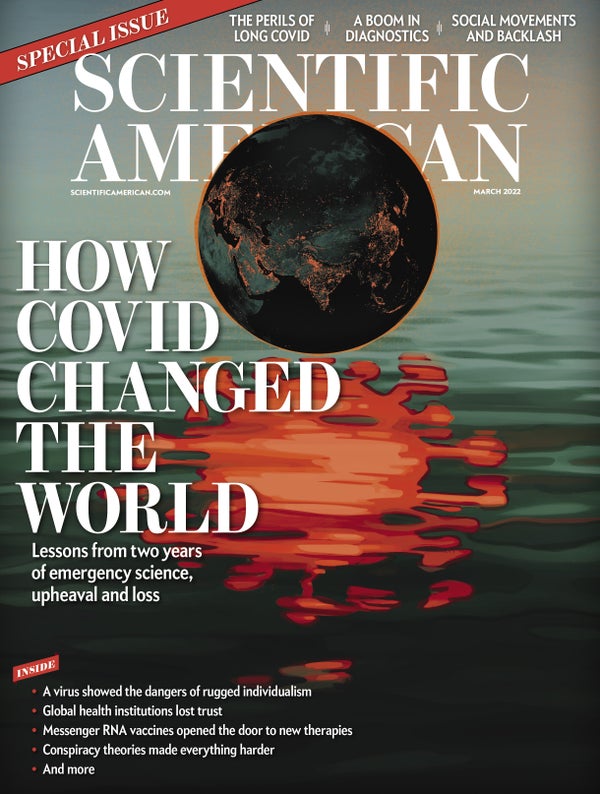
It’s been a tough two years. I hope you and yours are as safe and healthy as possible at this stage of the COVID pandemic. Like everyone, we at Scientific American have been thinking about this terrible disease constantly and trying to make sense of it. We’ve published hundreds of articles about the coronavirus itself, the immune system response, the astonishingly protective vaccines, the psychological toll on society, the trauma of health-care workers, deadly misinformation and the best ways to stop the spread of SARS-CoV-2. We meet weekly to brainstorm about the most important stories we should pursue to inform, engage and protect people, and even two years in we come up with dozens of ideas in every discussion.
In this issue, we look at how COVID has changed the world. We have 24 articles (don’t worry, some are quite short) that cover endeavors that have been directly and dramatically transformed, such as disease testing and vaccine development, as well as some of the more unexpected impacts, such as on climate conferences and rocket launches.
The main package of articles starts here, with an introduction by senior editor Jen Schwartz, who did brilliant work pulling these pieces together and making sense of the many ways that COVID disrupted society, accelerated research, and amplified the need for science and humanity. Most of the staff contributed to this report, beginning with the early brainstorming sessions (we do a lot of brainstorming), to make sure that we were representing many fields of research and segments of society. Our creative director, Michael Mrak, designed the section with clever illustrations and memorable images, thanks to photo editor Monica Bradley. Words are powerful, but graphics can be even more gripping. If you’re reading this issue in print, turn the pages sideways to see a stunning collection of data visualizations, created by graphics editors Amanda Montañez and Jen Christiansen, that show the profound ways COVID has shortened life span, transformed research, and changed education and the economy.
We’d like to hear from you: How has COVID changed your world? Please share your observations about the pandemic’s impact on your community, profession, hobbies, schools, or other aspects of life. We’ll publish your reports in our Letters to the Editor column, which you can reach at editors@sciam.com.
The COVID pandemic isn’t over, of course, and we’re anticipating years of important research findings. We’ll keep covering new insights on the immune system, long-term effects of viral infections, psychological resilience, children’s cognitive development, science-informed policies (we hope), and how to prevent or control the next pandemic. Some of this research will be conducted by people who were inspired by this disaster to pursue careers in science and health.
The 1918 flu pandemic killed an estimated 50 million to 100 million people around the world and raged for years. Afterward, historians have found, the catastrophe slid out of collective memory surprisingly quickly. We hope the dangers and disruption of COVID will ease soon, but we hope the lessons of COVID will last.