
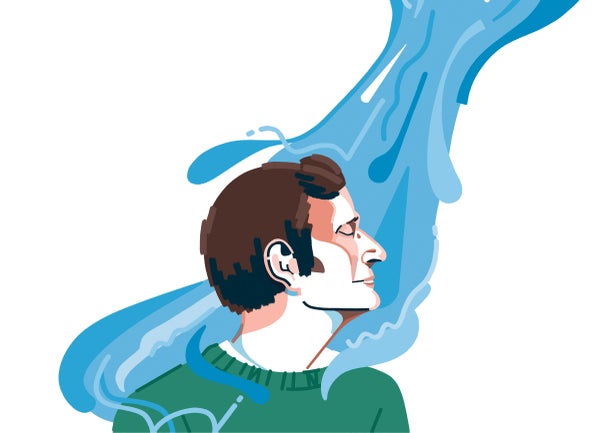
In 2008 Ecuador ratified a new constitution with a radical addition. In the first national declaration of its kind, articles 71 to 74 of the document granted rights to nature, recognizing Pacha Mama, or Mother Earth, as a living entity with the rights to exist, persist and be restored when damaged. In his latest book, Is a River Alive?, nature writer Robert Macfarlane travels to three different rivers (in Ecuador, India and eastern Canada) to examine the question of a river’s sovereignty. He documents the ways that rivers serve as the hearts of dynamic ecosystems and how people are beginning to take notice and protect them. As many Indigenous populations throughout the world have recognized for millennia, these bodies of water give life wherever they run. Yet rivers remain at risk as polluting corporations and governmental activities violate their vitalizing flow.
We spoke with Macfarlane about Is a River Alive? and the dramatic personal journey he went on while researching and writing the book.
An edited transcript of the interview follows.
On supporting science journalism
If you're enjoying this article, consider supporting our award-winning journalism by subscribing. By purchasing a subscription you are helping to ensure the future of impactful stories about the discoveries and ideas shaping our world today.

The central question of your book is: What inherent rights does nature have? And you explore the answer through the stories of rivers. What inspired you to tackle this existential topic?
In my country, England, rivers are in crisis. We do not have a single river in the country classified as being in “good overall health.” Pollution, drought and neglect have rendered many of our rivers first undrinkable, then unswimmable and now untouchable. This collapse is a crisis not just of legislation but of imagination; we have forgotten that our fate flows along with that of rivers and always has. I realized our relationship with rivers had become configured by a very young ideological story (that of privatization and assetization) and set out to find and tell “new old stories” about rivers, including those—from Ecuador, Canada and India—in which rivers were recognized as fellow subjects in the world, as beings who might have lives, deaths and even, yes, rights. It became without doubt the most urgent, absorbing, tumultuous book I’ve ever written, and the rivers, people and ideas I met in the course of its research continue to flow through my life nearly six years after I began the work.
It’s a very personal book. You travel and experience rivers firsthand, and you return over and over to the one in your own neighborhood. Do you think people need to be immersed in nature to truly have an appreciation for its inherent value?
We rarely care for what we do not love, and we rarely love what we cannot see, touch or feel. I powerfully believe that the revival of rivers worldwide—the “riverlution,” as Peruvian British environmental lawyer Monica Feria-Tinta has called it—is being driven by citizens who love their rivers, and this love is born of encounters with those rivers, whether as walkers, swimmers, fishers, paddlers or just everyday folk who draw inspiration, consolation and something like friendship from them. Where rivers retreat into invisibility (where they are buried or culverted underneath cities or placed beyond public access), they become easily forgotten and, once forgotten, easily degraded. But rivers are rare, and rivers are marvelous: only 0.0002 percent of the world’s water flows in rivers. When we meet a river, we should be as wonder-struck as if we’d just crossed paths with a snow leopard or condor!
My favorite section of the book was your kayak journey down the Mutehekau Shipu (Magpie River) in Quebec. How did that—quite riveting—experience shape what this book became?
Thank you. A riveting “rivering,” so to speak. The book gathers in speed and, I guess, force over its course as more and more tributaries of experience and idea flow into the main channel, braiding and weaving toward that final journey down a river that in 2021 had become the first in Canada’s history to have its rights declared. I and a small group of other people were dropped by floatplane about 110 miles up the watershed of the Mutehekau Shipu, which is the Innu-aimun name for the river, and we had to paddle out to reach the sea on the northern coast of the Gulf of St. Lawrence. Over the course of 11 days of travel, the physically and metaphysically intense permanent presence of the river did something to me that I am still reckoning with. It wore away the usual shells and screens of something like rationalism and left me open and vulnerable—in the best sense of that word—for what happened a day or two short of the sea at an immense cataract known just as “the Gorge.” Water can bury you, sure as Earth. I now know this.
“The physically and metaphysically intense permanent presence of the river did something to me that I am still reckoning with.” —Robert Macfarlane, nature writer
You return often to the relationship older societies and Indigenous people had and have with rivers—not as resources but as companions we share the planet with. What does this perspective bring to nature writing or to this story?
I wanted this book to be multivocal and polyphonic, to find a form in which other minds and voices, human and more than human, could illuminate its telling. I have always regarded what we curiously and negatively refer to as “nonfiction” to be a space of vast possibility in which styles and techniques learned from fiction, film, music, and other media can be woven together. And although I wanted the book to be in part made present to the reader through my “I” voice, I also wanted to allow the perspectives of my friends and companions through these years—among them Yuvan Aves, an extraordinary young Tamil naturalist and activist, and Innu poet, language keeper and community leader Rita Mestokosho—to sing out clearly.
What science is there to be learned from your book?
Oh! So much! I have a long history of fascination with science and regard the specialized languages of scientists as often remarkable, even lyrical, for the grace of exactitude they can demonstrate. In Is a River Alive? there is mycology—a lot of mycology!—hydrology, ecology, climatology, geomorphology, biology (at a metalevel, really, in terms of an inquiry into the definition of “life” itself), and numerous other -ologies. I am grateful to my endlessly patient scientific friends for their sharing of expertise and vision.
What other books on this or similar topics would you recommend?
Here are four very different books: Monica Feria-Tinta’s A Barrister for the Earth, Merlin Sheldrake’s Entangled Life, Elif Shafak’s There Are Rivers in the Sky and Moudhy Al-Rashid’s Between Two Rivers. Oh, and while I have you, Ursula K. Le Guin’s The Word for World Is Forest. And the Epic of Gilgamesh, as translated by Sophus Helle [Gilgamesh: A New Translation of the Ancient Epic]. Right. I must stop now, clearly, or this could run on and on.