
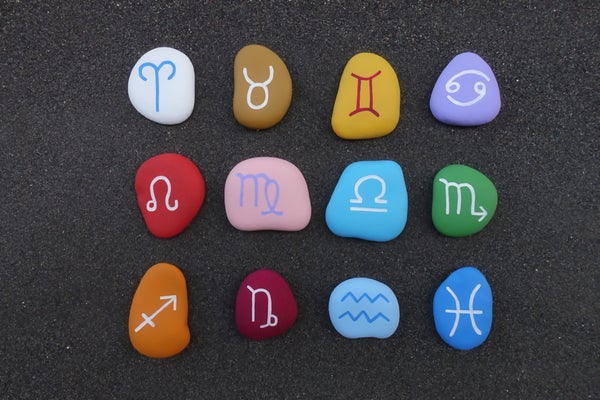
Is astrology real? Reading horoscopes is a popular diversion, but is there any science to suggest it means anything?
Inspiration finds you if you’re willing to dedicate yourself to a cause.
Problems may arise when you’re tempted by a familiar disruption and your willpower weakens.
On supporting science journalism
If you're enjoying this article, consider supporting our award-winning journalism by subscribing. By purchasing a subscription you are helping to ensure the future of impactful stories about the discoveries and ideas shaping our world today.
Something appearing meaningless may be a lesson to learn.
As many as 70 million Americans read their horoscopes daily. Well, that’s at least according to the American Federation of Astrologers. According to a study done twenty years ago by the Pew Forum on Religion & Public Life, 25 percent of Americans believed that the positions of the stars and the planets affect our daily lives. In 2012, the General Social Survey found that 34 percent of Americans surveyed consider astrology to be "very" or "sort of scientific" and also reported a decrease—from two-thirds to around one-half—in the fraction of people who consider astrology "not at all scientific."
Astrology is generally defined as the belief that astronomical phenomena, like the stars overhead when you were born or the fact that Mercury is in retrograde, have the power to influence the daily events in our lives and our personality traits. This is, of course, very different from the study of astronomy, which is the scientific study of celestial objects, space, and the physics of the universe.
A specific aspect of astrology—the forecasting of a person’s future or the offering of advice on daily activities via horoscopes—is particularly growing in popularity. Magazines like The Cut reported an increase of 150 percent more hits on horoscope pages in 2017 than in 2016.
Clearly, lots of people are looking for ways to interpret the stars for advice. Astrology is founded on understanding the positions of the stars, which seems like a scientific enough pursuit in itself. But is there any science to back up whether astrology impacts our personality and our lives?
Here's the short Answer: No. None whatsoever.
But since I have you for five more minutes of this six-minute-or-so podcast to fill, let’s look at exactly how astrology has been tested.
Continue reading “Is Astrology Real? Here's What Science Says” on QuickAndDirtyTips.com