
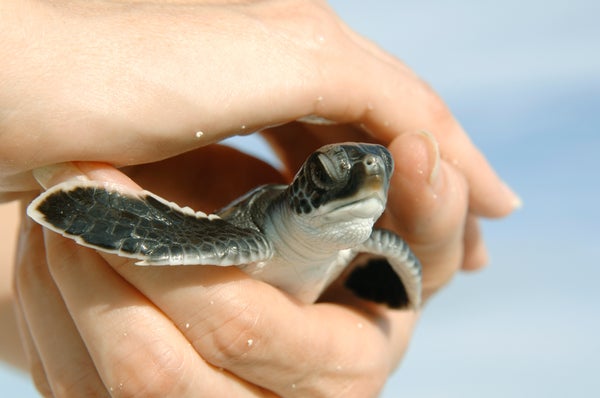
When it comes to predicting the sex of a baby sea turtle, biologist Jeanette Wyneken has often heard her students use a simple guideline: “hot chicks, cool dudes.”
That’s because unlike humans, the sex of sea turtle isn’t determined by chromosomes. A host of external environmental factors can influence whether an egg hatches a male or female turtle, and one of those factors is temperature: Warmer conditions birth more females, whereas cooler ones produce males.
In recent years, scientists have been noticing an overwhelming proportion of female hatchlings on Florida’s beaches, possibly because of steady temperature increases in the region. It’s worrisome, they say, because a skewed sex ratio could affect the future of the species as a whole.
On supporting science journalism
If you're enjoying this article, consider supporting our award-winning journalism by subscribing. By purchasing a subscription you are helping to ensure the future of impactful stories about the discoveries and ideas shaping our world today.
“Sea turtles are an endangered species,” said Wyneken, “and one of the things that needs to happen when you’re trying to recover an endangered species is you need to know what impediments there are to making more turtles—are there enough eggs? Are they hatching? And if so, are there enough of both sexes? We’re dealing with the last part of it.”
But predicting a hatchling’s sex can be a tricky affair because some sea turtle species have complex biological features. As Wyneken puts it, “it’s almost as if the gonad hasn’t decided whether it’s going to be a testis or an ovary.” Some of the common practices that scientists use include making estimations based on beach temperatures or laboratory data, but these aren’t necessarily accurate.
Wyneken and her colleagues at the Florida Atlantic University have developed a new method, one that’s demonstrably more reliable. It could provide a backbone for sea turtle conservancy efforts, since there’s a lot that researchers don’t yet know about the species’ demographic profile and how an abundance of females could affect populations.
“We tried this technique, which responds to a protein on the cells of the female gonad—if it’s a female, you get a lot of staining, whereas in males you don’t,” explained Wyneken.
The team was able to verify the technique on loggerhead turtles, a species that has a simpler biology that allows for better sex determination. Once researchers realized it was reliable, they could apply it to species that are harder to identify, like leatherbacks.
Every year, close to 50,000 sea turtles trek up to Florida’s beaches and lay clutches of golf-ball-sized eggs, which they then carefully cover with sand. In the last 12 years, said Boris Tezak, a graduate student with FAU, there’s been a strong female bias in the hatchlings that emerge a few months later. In the last five years, that bias has been even more skewed, even touching 95 percent female in some cases.
There’s a likelihood that increasing temperatures in the region have contributed to this female abundance.
“But the problem is we don’t know what sex ratios were like 15, 20 or 25 years ago,” said Tezak. “It’s possible that there’s been a slight female bias for a long time, but it’s unlikely to this extent. That’s why this research is so important—it provides a baseline to establish how adaptation strategies will go.”
A reliable, relatively inexpensive method to determine hatchlings’ sex without harming them would be welcomed by the conservation community, said David Godfrey, executive director of the Sea Turtle Conservancy.
“You have here a direct link between global warming and the survival of the species, or certainly the population makeup of the species. We know that warmer incubation temperatures produce a greater number of females, and there’s concern and evidence that some beaches are producing either all or primarily females. So yes, from a conservation standpoint, this has significant ramifications,” he said.
At the same time, he cautions against using this information to start manipulating sex ratios. Climatic changes might be leading to a higher number of females, but scientists don’t know enough to state definitely that that’s necessarily bad for the species, or that a 50-50 male-to-female ratio is the ideal, he said.
“Not unlike some in our species, males are opportunistic breeders. They’re hanging out in places where the girls are and not sticking to just one. Having a greater percentage of females, at least for a period of time, could be beneficial because you have a lot of egg-layers. That is the next place where study is needed,” he said.
Reprinted from Climatewire with permission from E&E News. E&E provides daily coverage of essential energy and environmental news at www.eenews.net.