
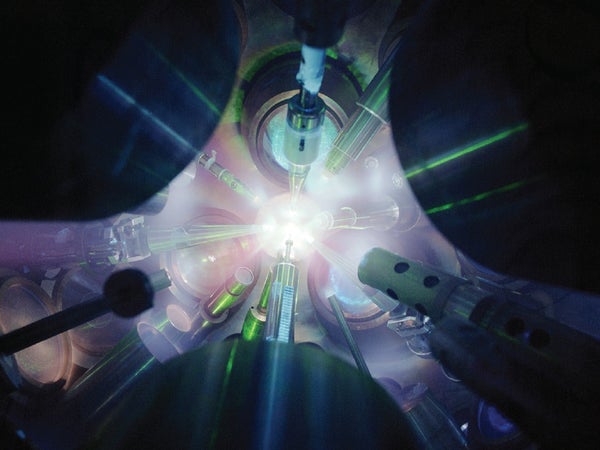
John Holdren has heard the old joke a million times: fusion energy is 30 years away—and always will be. Despite the broken promises, Holdren, who early in his career worked as a physicist on fusion power, believes passionately that fusion research has been worth the billions spent over the past few decades—and that the work should continue. In December, Scientific American talked with Holdren, outgoing director of the federal Office of Science and Technology Policy, to discuss the Obama administration's science legacy. An edited excerpt of his thoughts on the U.S.'s energy investments follows.
Scientific American: Have we been investing enough in research on energy technologies?
John Holdren: I think that we should be spending in the range of three to four times as much on energy research and development overall as we've been spending. Every major study of energy R&D in relation to the magnitude of the challenges, the size of the opportunities and the important possibilities that we're not pursuing for lack of money concludes that we should be spending much more.
On supporting science journalism
If you're enjoying this article, consider supporting our award-winning journalism by subscribing. By purchasing a subscription you are helping to ensure the future of impactful stories about the discoveries and ideas shaping our world today.
But we have national labs that are devoted—
I'm counting what the national labs are doing in the federal government's effort. We just need to be doing more—and that's true right across the board. We need to be doing more on advanced biofuels. We need to be doing more on carbon capture and sequestration. We need to be doing more on advanced nuclear technologies. We need to be doing more on fusion, for heaven's sake.
Fusion? Really?
Fusion is not going to generate a kilowatt-hour before 2050, in my judgment, but—
Hasn't fusion been 30 years away for the past 30 years?
It's actually worse than that. I started working on fusion in 1966. I did my master's thesis at M.I.T. in plasma physics, and at that time people thought we'd have fusion by 1980. It was only 14 years away. By 1980 it was 20 years away. By 2000 it was 35 years away. But if you look at the pace of progress in fusion over most of that period, it's been faster than Moore's law in terms of the performance of the devices—and it would be nice to have a cleaner, safer, less proliferation-prone version of nuclear energy than fission.
My position is not that we know fusion will emerge as an attractive energy source by 2050 or 2075 but that it's worth putting some money on the bet because we don't have all that many essentially inexhaustible energy options. There are the renewables. There are efficient breeder reactors, which have many rather unattractive characteristics in terms of requiring what amounts to a plutonium economy—at least with current technology—and trafficking in large quantities of weapon-usable materials.
The other thing that's kind of an interesting side note is if we ever are going to go to the stars, the only propulsion that's going to get us there is fusion.
Are we talking warp drive?
No, I'm talking about going to the stars at some substantial fraction of the speed of light.
When will we know if fusion is going to work?
The reason we should stick with ITER [a fusion project based in France] is that it is the only current hope for producing a burning plasma, and until we can understand and master the physics of a burning plasma—a plasma that is generating enough fusion energy to sustain its temperature and density—we will not know whether fusion can ever be managed as a practical energy source, either for terrestrial power generation or for space propulsion. I'm fine with taking a hard look at fusion every five years and deciding whether it's still worth a candle, but for the time being I think it is.
To read more of the conversation with John Holdren—which includes his assessment of the future of U.S. science policy, the prospects for continued progress on brain science, and more—visit www.ScientificAmerican.com/john-holdren