
The White House this week released its plan to confront the national opioid crisis, roiling urban and rural communities alike. In a three-page document circulated to news outlets and later posted on the White House Web site, Pres. Donald Trump lays out a strategy focused on scaling up law enforcement actions, boosting education about substance use and expanding access to treatment. But critics, including some human rights and public health groups, say aspects of the plan are too reminiscent of the “war on drugs” approach that has failed in the past.
The most controversial point calls for using the death penalty against some drug traffickers. Human rights groups say this would be immoral and would not actually reduce crime, but Trump said Monday the move would be necessary if the U.S. is going to “get tough” on fighting opioid abuse. The White House document specifies that the death penalty would be used only in cases where appropriate “under current law.” That distinction would mean it could only be used when a drug trafficker is directly involved in a murder, says Vanita Gupta, president of The Leadership Conference on Civil and Human Rights and a former head of the U.S. Department of Justice’s Civil Rights Division.
Many aspects of the new approach resemble those put forward by Trump’s Commission on Combating Drug Addiction and the Opioid Crisis. There are also numerous similarities to the July 2017 recommendations from The National Academies of Sciences, Engineering and Medicine panel convened on this topic, although that group did not suggest law enforcement measures, which were beyond its purview. In their lengthy reports, both the Commission and the National Academies group sought to expand treatment options, to better educate clinicians about prescribing painkillers and to drill down on ways to more efficiently use prescription drug monitoring programs. The president’s three-page bulleted plan does as well.
On supporting science journalism
If you're enjoying this article, consider supporting our award-winning journalism by subscribing. By purchasing a subscription you are helping to ensure the future of impactful stories about the discoveries and ideas shaping our world today.
David Clark, a Stanford University anesthesiology professor and a member of the National Academies committee that released earlier recommendations, applauds aspects of the new plan. But he cautions “the approach as outlined does have a good deal of material reminiscent of the ‘war on drugs’ that was not too successful in this country or in others.” Along with the death penalty provision, the White House plan calls on Congress to pass legislation lowering the quantity of confiscated drugs that would trigger a mandatory minimum sentence for traffickers who knowingly distribute certain illicit opioids that are lethal in trace amounts (such as fentanyl and fentanyl analogs). The plan also emphasizes securing land borders, ports of entry and waterways against smuggling.
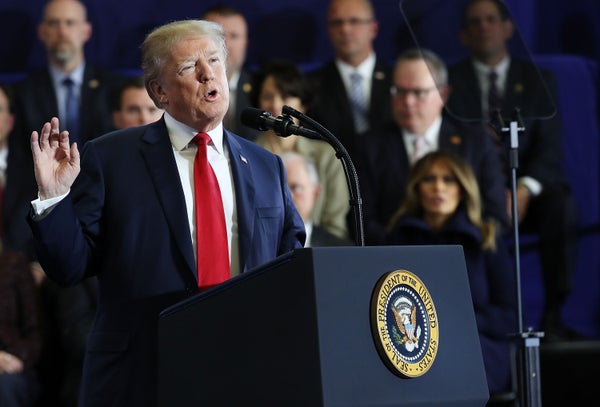
During public remarks in New Hampshire on Monday, Trump said that in putting the plan together he had accepted all 56 of the Commission’s recommendations—including ones that would help people get into residential substance abuse treatment facilities, and get access to medication-assisted treatment. The Commission had called for legislation that would enable the Centers for Medicare and Medicaid Services to expand reimbursement for inpatient substance abuse treatments, which the White House supports. It had also advocated for the continued development of new techniques and technologies to combat addiction, and for expanding prescription drug abuse monitoring programs. It further said first responders should carry adequate supplies of naloxone, the drug overdose antidote—provisions that are included in the president’s plan.
Yet parts of the White House’s blueprint do not explicitly go as far as the Commission had suggested. For example, the latter had urged first responders to keep comprehensive records on naloxone deployment and its outcomes, and to record them in the databases of drug-monitoring programs. The White House document does not specifically touch on this idea.
Trump said his approach, if enacted, would slash opioid prescriptions by one third in three years. That number “may be a realistic goal,” Clark says, noting the Department of Veterans’ Affairs has made substantial progress in reducing its own painkiller prescriptions in recent years. The department says its opioid-prescribing rates have dropped 41 percent between 2012 and 2017. Public pressure, better education and greater awareness around opioid addiction may help trigger similar gains.
Yet the opioid crisis is far from over. Earlier this month the U.S. Centers for Disease Control and Prevention released a new report stating emergency room visits due to opioid overdoses jumped 30 percent just last summer. As CDC Acting Director Anne Schuchat said in a statement at the time, “Long before we receive data from death certificates, emergency department data can point to alarming increases in opioid overdoses.”