
On supporting science journalism
If you're enjoying this article, consider supporting our award-winning journalism by subscribing. By purchasing a subscription you are helping to ensure the future of impactful stories about the discoveries and ideas shaping our world today.
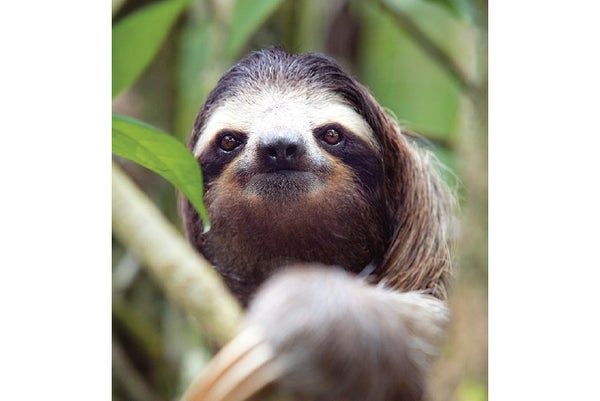
After seven years of studying three-toed sloths, scientists at the University of Wisconsin–Madison have made it official: the tree-dwelling animals are the slowest mammals on earth, metabolically speaking. “We expected them to have low metabolic rates, but we found them to have tremendously low energy needs,” says ecologist Jonathan Pauli.
To reach this conclusion, Pauli and his colleague M. Zachariah Peery measured the metabolic rates of 10 three-toed sloths and 12 of the two-toed variety in Costa Rica and compared the results with similar studies of 19 other species of leaf-eating mammals. With a metabolic rate of 162 kilojoules per day per kilogram, the three-toed sloths have lower energy needs than koalas, which require 410 kilojoules per day per kilogram. Two-toed sloths, meanwhile, have an energetic expenditure of 234. Giant pandas are the only contenders that come close to the title of slowest mammal—at 185 kilojoules.
According to the study, published in August in American Naturalist, there is a suite of behavioral, physiological and anatomical adaptations that allow sloths to lead minimally exerting lives in the jungle canopies of Central and South America. For example, they have small home ranges and spend most of their time eating, resting or sleeping. They also have the rare ability to adjust their internal thermostat. “They're slightly heterothermic, so they can fluctuate their body temperature by about five degrees Celsius to be in line with the outside temperature. By relaxing their body temperature, they have big savings in terms of energetic output,” Pauli explains. Who said sloth was a deadly sin?