
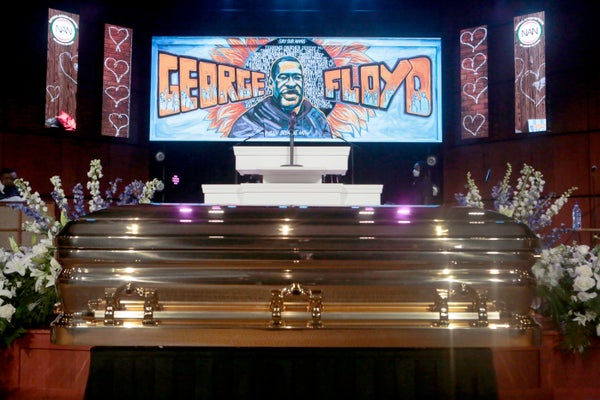
A video documenting the final moments of life for George Floyd has sparked massive protests in every part of the country and international outrage. The video, which has been watched by millions, offers a stark testimony to a long-endured tragedy. Because of what it captures, it will likely mark a turning point in history. Yet, the video, and others like it, are also condemned for what they show.
Some have denounced the video—some calling it pain porn—arguing that images of people being killed should never be made public. However, many others, including Mr. Floyd’s family members, have expressed gratitude that the tragedy was caught on camera so that it could be viewed widely and galvanize change.
Horrific videos like these trigger two fundamentally different responses that capture how deeply conflicted we are about documenting death.
On supporting science journalism
If you're enjoying this article, consider supporting our award-winning journalism by subscribing. By purchasing a subscription you are helping to ensure the future of impactful stories about the discoveries and ideas shaping our world today.
As someone who studies the portrayal of death in the media, and wrote the book Death Makes the News: How the News Media Censor and Display the Dead, I am often asked about these images and their effects. One of the first things I learned through my research is that news images of death are extremely rare, contrary to what many assume. About 1 percent of published news photographs actually show the victim’s final moments or the body. By observing the industry behind-the-scenes, it became clear editors have access to many of these images but they repeatedly reject them as unethical.
The video of Floyd is an exception. Typically, Americans demand that images of the dead or dying be kept out of public view. For example, it is taboo to show dead American soldiers or the bodies at the site of a domestic disaster, such as 9/11; any of the mass shootings; tropical cyclones; and the current coronavirus epidemic. And on the rare occasions that a postmortem picture is published, controversy follows, with critics condemning it as “deplorable,”“exploitive,” and even “pornographic,” “degrading” or “craven and unforgivable.” Death, they argue, demands privacy.
The photo of the three-year old Syrian victim who lay dead on a beach was, for example, denounced as a “snuff photo.” The publication of an Associated Press photo that showed a young father and his 23-month-old daughter, dead on the banks of the Rio Grande, provoked complaints that the image is dehumanizing and disrespectful. Similarly, when media showed victims killed by Haiti’s devastating earthquake in 2010, viewers judged the pictures “inhumane.” They argued that, out of respect for the dead and their families, such images should be banned.
Speaking on behalf of the deceased and family members, some argue that these kinds of images victimize the victim again, cruelly compounding the calamity and causing surviving family members “indelible trauma.”
When two girls living in a remote Indian village were gang raped in a field and then hung from a large mango tree, some American news coverage included photos of their lifeless bodies. But because violence against girls is typically ignored, the parents desperately wanted the horrific hanging to be shown by local, national, and international news outlets so that authorities would be pressured to investigate. They felt that photographs testifying to the tragedy offered a path towards justice, and that privacy would only make it harder to achieve. The father of the youngest girl explained, he “didn’t have any problems with people taking photographs; the problem is the thing that happened with our children.”
Other parents who have lost a child also depend on the news media to expose the awfulness. Some U.S. military families have argued that we should confront the real cost of war by seeing the ultimate sacrifice, un-sanitized. During the Iraq war, when the news media shared pictures from Baghdad of Army Spc. Travis Babbitt in his last moments of life, his anguished mother explained, “I do think it’s an important thing for people to see what goes on over there.”
With the 20th anniversary of the Columbine High School massacre, a few students started a campaign to share images of bodies killed by guns with the press, hoping to capture the nation’s attention and combat gun violence. They asked other students to place a sticker on their driver’s license or cellphone that pledges: “In the event that I die from gun violence, please publicize the photo of my death.”
African American scholars and activists have long credited the camera as an agent of change. In 1955, a burning desire for justice was galvanized by the images of Emmett Till in his open casket. Till’s mother invited the press to publish photographs of her son’s mutilated body, later recalling that “we had averted our eyes for far too long, turning away from the ugly reality facing us as a nation.”
In 2015, when the death of Walter Scott was publicly witnessed, his father offered that, without the images, the injustice “would have never come to light.” Precisely because they made death visible, these images have helped strengthen the 21st century’s civil rights movement, Black Lives Matter.
The video capturing Floyd's death has reminded us that when cameras capture a tragedy they can protect it from neglect. Floyd's uncle has recently described Darnella Frazier, the 17-year-old who posted the video of his nephew’s murder, as his “hero” because without her, “none of this would have ever been known.” He was comforted by the fact that millions of people “have seen my nephew get murdered in the streets of Minneapolis." Indeed, it may have already catalyzed the next chapter of the civil rights movement.
Privacy is a privilege that many cannot afford. When we equate graphic news images with an ethical sin, we ignore some very important struggles for visibility. If we allow the camera to avert its gaze, or if we try to communicate about a tragedy while censoring images of death, much will be lost. Sometimes the harm is not in showing, but in hiding, the tragedy—the sin of omission that allows the tragedy to be more easily ignored.