
From space Earth is simply a pale blue dot. It's blue because of all the water on its surface. In fact, a little more than 70 percent of the Earth's surface is covered by water, most of it ocean. But how much water is there, really?
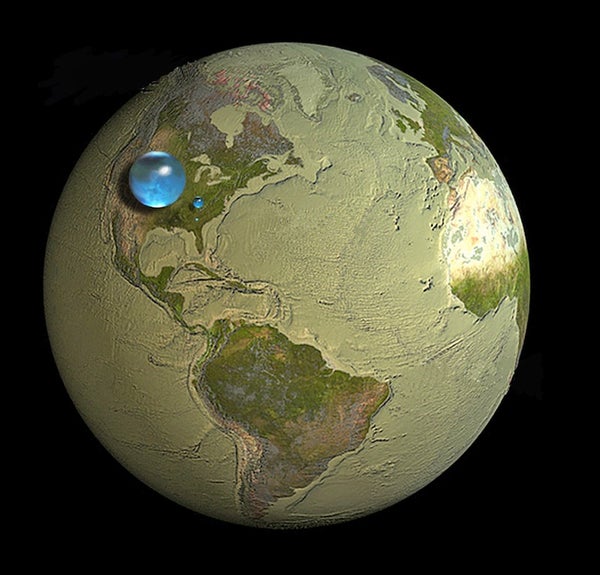
This image, produced by the U.S. Geological Survey (USGS), shows all of Earth's water in three little orbs. The big one, over the western U.S., is all the water in the world—everything from the salty oceans to the water found deep underground. It looks small compared with the size of Earth, but that sphere's volume is 1.38 billion cubic kilometers and it is about 1,385 kilometers in diameter. The smaller floating sphere in the middle at 272.8 kilometers in diameter represents a subset of that bigger sphere, showing freshwater in the ground, lakes, swamps and rivers. It doesn't include permanent ice- and snowpacks locked in the polar ice caps—which is where much of the world's freshwater is held; humans, unfortunately, do not have access to this supply. The tiny speck next to it represents and even smaller subset of all the water– just the freshwater in lakes and rivers. It, too, seems tiny by comparison with the big orb, but it is 56.2 kilometers in diameter.
On supporting science journalism
If you're enjoying this article, consider supporting our award-winning journalism by subscribing. By purchasing a subscription you are helping to ensure the future of impactful stories about the discoveries and ideas shaping our world today.
To figure out how big these bubbles would be, the USGS looked at estimates for how much water was in everything from the oceans to swamps. Of course, it's impossible to measure exactly how much water fills the oceans, let alone how much is trapped deep underground. But taking the best estimates available, the USGS artists computed the size of each sphere and placed them on top of the planet.
So where is all that water? Perhaps surprisingly, although oceans, seas and bays cover 70 percent of the world, they contain about 96 percent of its water—all of it salty. The next biggest category is ice caps, glaciers and permanent snow at the poles and peaks, but that only makes up about 1.74 percent of the world's water. Groundwater, both fresh and salty, is the next highest contributor to the blue orbs, making up an estimated 1.69 percent of the world's water. In fact, there is much more freshwater in the ground than there is on the surface in lakes and rivers.
Humans consume vast quantities of both surface and groundwater every day. In 2005 we used 1.24 trillion liters of surface water and 312.7 billion liters of groundwater daily. So while those orbs might seem surprisingly small, they're sustaining the whole human population.
>>See our in-depth report, Earth Thirst: Solving the Freshwater Crisis
—Rose Eveleth