It’s All in the Mix

A new form of color blending produces surprising palettes

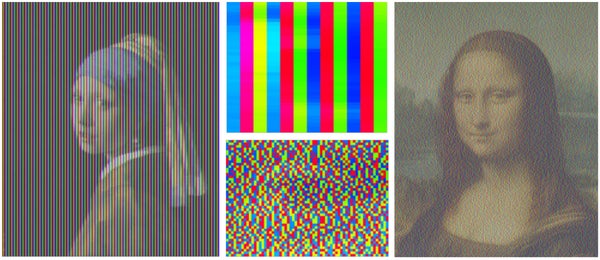
Akiyoshi Kitaoka's versions of Vermeer's "Girl With A Pearl Earring" (left) and Leonardo's "Mona Lisa" (right).

Akiyoshi Kitaoka

Join Our Community of Science Lovers!

Akiyoshi Kitaoka of the Ritsumeikan University in Japan, inventor of countless brain-crushing misperceptions, straddles the realms of visual science and art perhaps more than any other illusion creator today. His newest discovery combines additive and subtractive chromatic schemes to represent opposite ends of an illumination spectrum, bringing new understanding to how we perceive color and brightness.

Kitaoka’s breakthrough arose from his realization that he could use vivid colors to create both the dark and bright extremes of the luminance scale. In other words, that he could display full-blast Red, Green, and Blue (RGB) pixels on a screen to generate the perception of not only vibrant hues, but also dim, shady ones—such as depicted in the images at the top of this page [TK].

Using an RGB scheme to represent the dark end of a brightness spectrum meant that Kitaoka needed even brighter colors to portray the lighter end of the spectrum. The candidate hues were mixes of other vivid colors, such as Cyan (blue + green), Magenta (blue + red), and Yellow (green + red)—or CMY for short.


On supporting science journalism

If you're enjoying this article, consider supporting our award-winning journalism by subscribing. By purchasing a subscription you are helping to ensure the future of impactful stories about the discoveries and ideas shaping our world today.


These color schemes—RGB versus CMY—have been used for decades as the most common methods of additive and subtractive color mixing. In additive color mixing, such as on a video screen, RGB pixels mix in different amounts to add up to the desired color and brightness. In subtractive color mixing, such as in printing (e.g. color printers, t-shirts), dyes that absorb light mix with one another. Hence, red light absorption from white light results in Cyan, green absorption results in Magenta, and blue absorption results in Yellow.

By featuring additive and subtractive color mixing in the same image, Kitaoka’s hybrid color scheme accomplishes both dark and light levels of brightness and color, even though each point in the image is blazing at full power.

This “intermediate color mixture” not only bridges additive and subtractive processes, Kitaoka says, but it also reveals that “human vision can distinguish these types of spatial (or temporal) color mixes and perceive every color and lightness from black to white in each image.”  

Stephen Macknik is a professor of ophthalmology, neurology, and physiology and pharmacology at SUNY Downstate Health Sciences University in Brooklyn, N.Y. Along with Susana Martinez-Conde and Sandra Blakeslee, he is author of the Prisma Prize–winning Sleights of Mind. He is also author of Champions of Illusion, along with Susana Martinez-Conde. Follow Macknik on Twitter @stephen_macknik

More by Stephen Macknik

Susana Martinez-Conde is a professor of ophthalmology, neurology, and physiology and pharmacology at SUNY Downstate Health Sciences University in Brooklyn, N.Y. She is author of the Prisma Prize–winning Sleights of Mind, along with Stephen Macknik and Sandra Blakeslee, and of Champions of Illusion, along with Stephen Macknik.

More by Susana Martinez-Conde
SA Mind Vol 32 Issue 4This article was published with the title “It's All in the Mix” in SA Mind Vol. 32 No. 4 (), p. 34
doi:10.1038/scientificamericanmind0821-34

It’s Time to Stand Up for Science

If you enjoyed this article, I’d like to ask for your support. Scientific American has served as an advocate for science and industry for 180 years, and right now may be the most critical moment in that two-century history.

I’ve been a Scientific American subscriber since I was 12 years old, and it helped shape the way I look at the world. SciAm always educates and delights me, and inspires a sense of awe for our vast, beautiful universe. I hope it does that for you, too.

If you subscribe to Scientific American, you help ensure that our coverage is centered on meaningful research and discovery; that we have the resources to report on the decisions that threaten labs across the U.S.; and that we support both budding and working scientists at a time when the value of science itself too often goes unrecognized.

In return, you get essential news, captivating podcasts, brilliant infographics, can't-miss newsletters, must-watch videos, challenging games, and the science world's best writing and reporting. You can even gift someone a subscription.

There has never been a more important time for us to stand up and show why science matters. I hope you’ll support us in that mission.

Thank you,

David M. Ewalt, Editor in Chief, Scientific American

Subscribe