
On supporting science journalism
If you're enjoying this article, consider supporting our award-winning journalism by subscribing. By purchasing a subscription you are helping to ensure the future of impactful stories about the discoveries and ideas shaping our world today.
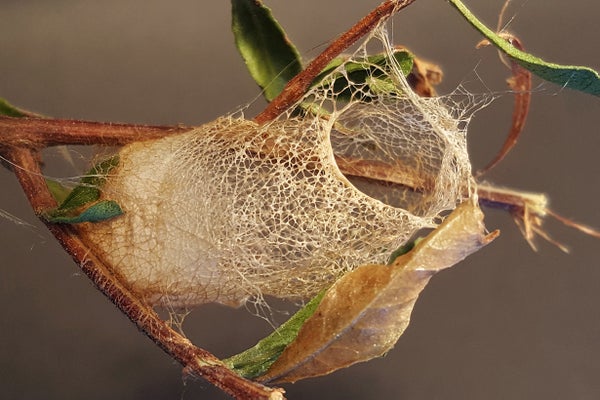
Wallabies, kangaroos, koalas—Australia is home to organisms found nowhere else on Earth, a characteristic that extends from furry mammals all the way to the basket-web spider. Part of what makes this arachnid so distinct is in its name. Often called the “lobster pot spider,” the species Saccodomus formivorus whips up open-mouthed cocoons that catch prey and swaddle eggs. Evolutionary biologists think that spiders originally wove webs to protect their unhatched young. This unusual rendition might be a rare example of an ancestral spider habit that is still alive today. Each multipurpose sack is less than half an inch wide and about half an inch deep. The little marvel would fit comfortably on the surface of a penny.
According to new research, the silk the basket-web spider uses is also fairly unique. Each thread intertwines two chemically distinct fibers, which together offer the stretch and durability needed for the 3-D construction. “Nature has created a complex structure that, at first glance, resembles industrially produced composites,” said Thomas Scheibel, a biomaterials researcher at the University of Bayreuth in Germany, who conducted the research,said study co-author Thomas Scheibel, a biomaterials researcher at the University of Bayreuth in Germany, in October press releases from Bayreuth and the University of Melbourne in Australia. The strands can withstand some forces better than similar fibers ejected by spiders that spin traditional 2-D webs—a serious accomplishment, seeing as the latter silks were already considered nearly as durable as high-tech materials.