
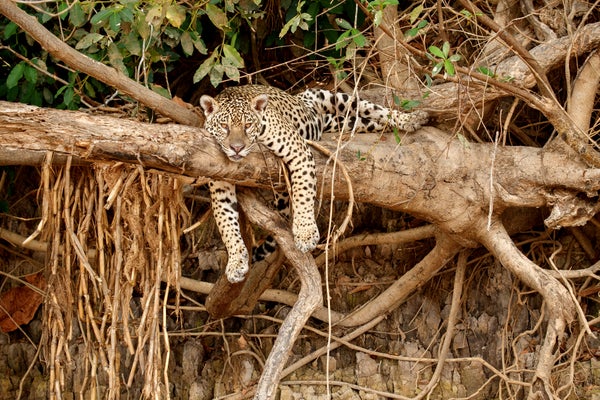
Jaguars, the largest big cats in the Americas, need a lot of space. One male can roam a territory spanning tens of square kilometers in search of mates and prey. But as ranching, crop farming and other forms of development encroach on tropical forests, these fearsome predators are losing ground.
A study published in the April issue of Biological Conservation offers hope. Scientists at the San Diego Zoo, the Wildlife Conservation Society, and Peru's National Forest and Wildlife Service found that in some lightly logged forests in Guatemala and Peru—certified by independent experts as “well managed”—jaguar densities were comparable to those in protected areas or other high-quality habitats. The study adds to a growing body of evidence that such forests can serve as important habitat corridors for the wide-ranging felines.
The researchers examined logging concessions in Guatemala's Maya Biosphere Reserve, an internationally recognized conservation area with three levels of protection: a core of national parks; a buffer zone that allows farming and ranching; and a multiuse area that allows limited logging but excludes livestock. All forestry operations in the reserve must be certified by the independent nonprofit Forest Stewardship Council (FSC). Established by an international consortium of conservation and industry groups in 1993, the FSC sets standards that permit very low intensity timber harvesting. Hunting in the forest areas studied is strictly banned, and access roads are guarded, although some subsistence hunting does occur elsewhere in the reserve.
On supporting science journalism
If you're enjoying this article, consider supporting our award-winning journalism by subscribing. By purchasing a subscription you are helping to ensure the future of impactful stories about the discoveries and ideas shaping our world today.
The scientists used camera traps and a multispecies computational model to determine that jaguar density in the Maya Biosphere Reserve was comparable to that in similar habitats in the Gran Chaco region in Bolivia and Emas National Park in Brazil. In Peru, the researchers applied the same techniques to FSC-certified forests in the Amazon basin's Madre de Dios region and found even greater jaguar densities. In both Guatemala and Peru, they detected over 20 other mammal species, including prey for the big cats. The newly opened canopy may have encouraged growth of the plants they eat.
Anand Roopsind, a postdoctoral research fellow at Boise State University, who was not involved in the new study, says these findings reaffirm other research demonstrating the value of lightly logged forests for jaguar conservation. The FSC enjoys significant support among conservationists. But some have criticized aspects of the program, such as potential conflicts of interest; certifiers are hired directly by logging companies.
Nevertheless, both Roopsind and study co-author John Polisar, coordinator of the Jaguar Conservation Program for the Wildlife Conservation Society, stress that lightly logged areas can act as vital conduits between more heavily protected areas. “If we manage forests really well, the impact on big mammals is minimal, and it's much better than conversion to ranchland or agriculture,” Roopsind says. Polisar goes a step further: “If jaguar densities are good,” he says, “you know the forest is well managed.”