
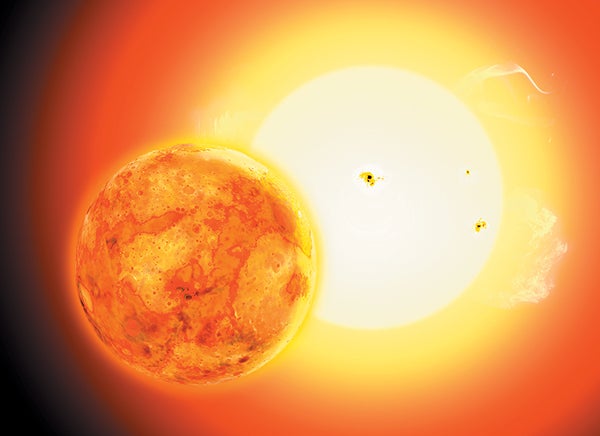
Astronomers have found an atmosphere where they least expected it: clinging to an exoplanet that’s too small, too hot and too old to have air, at least in theory.
Observations by the James Webb Space Telescope (JWST) of the blazing-hot lava planet TOI-561 b suggest not only that it cultivates a thick atmosphere but also that it might have had one for billions of years. This evidence is the strongest yet on a hot, rocky world for air that isn’t just a temporary veil of hydrogen and helium left over from planetary formation. The paper reporting the discovery, posted on the preprint server arXiv.org, will soon appear in the Astrophysical Journal Letters.
“It’s super old and ultrahot. It’s the worst conditions,” says study co-author Tim Lichtenberg, a planetary scientist at the University of Groningen in the Netherlands. “This planet should not have an atmosphere. And it has one.”
On supporting science journalism
If you're enjoying this article, consider supporting our award-winning journalism by subscribing. By purchasing a subscription you are helping to ensure the future of impactful stories about the discoveries and ideas shaping our world today.
Planetary scientist Joshua Krissansen-Totton of the University of Washington, who wasn’t involved in the study, agrees. “It is definitely surprising and exciting to find a substantial atmosphere on this hot, rocky planet,” he says.
In our solar system, atmospheres obey a simple rule: bigger, cooler worlds hold on to their air, and smaller, warmer ones don’t. But TOI-561 b weighs in at just two Earth masses and is very, very hot; the planet orbits so close to its yellow dwarf star that its year lasts less than an Earth day, and its estimated temperature is a rock-melting 2,300 kelvins. TOI-561 b is also about twice as old as our solar system, so its radiation-blasted atmosphere would have had plenty of time to escape. But researchers suspected the planet might be more than a bare ball of magma because of its unusually low density. And scientists previously spotted air on a bigger, hot super-Earth called 55 Cancri e, although the data were “messy and weird,” Krissansen-Totton says.

New research suggests a rocky “lava planet” orbiting very close to its star likely carries an atmosphere.
Chris Butler/Science Source
To check for alien air, the research team used JWST to take TOI-561 b’s temperature. The planet is tidally locked, so one side bakes in ceaseless radiation while the other is always dark. The scientists found that TOI-561 b’s light-soaked dayside was cooler than they would expect for a naked rock—most likely because gas was there to spread the heat around.
The team is “confident” that an atmosphere is the best explanation for the data, says exoplanet astronomer and study lead author Johanna K. Teske of Carnegie Science in Washington, D.C. But finding an unexpected atmosphere “is the kind of result that generates more questions than it answers,” she adds.
For one, scientists don’t know what TOI-561 b’s air is made of or how it survived eons of hellish heat. Lichtenberg thinks the atmosphere probably bubbled up from the planet’s magma ocean. Every planet in our solar system was once molten like TOI-561 b, he points out; this unexpected atmosphere could have a lot to teach us about the origins of our own.