
HONOLULU — NASA's next flagship space telescope is still on track for a launch in March 2021 despite long-standing scheduling concerns, according to agency personnel.
The
James Webb Space Telescope has been notoriously prone to delays and cost overruns, but during two town hall meetings held here at the 235th American Astronomical Society meeting, NASA leaders emphasized that the launch date set in June 2018 still holds. A second major telescope is also continuing to meet its timeline, targeting a launch in the mid-2020s.
On supporting science journalism
If you're enjoying this article, consider supporting our award-winning journalism by subscribing. By purchasing a subscription you are helping to ensure the future of impactful stories about the discoveries and ideas shaping our world today.
"This past year was an exciting year for James Webb," Paul Hertz, director of the astrophysics division of NASA's Science Mission Directorate, said of Webb on Sunday (Jan. 5) during an update about the astrophysics program. "This is your next great observatory."
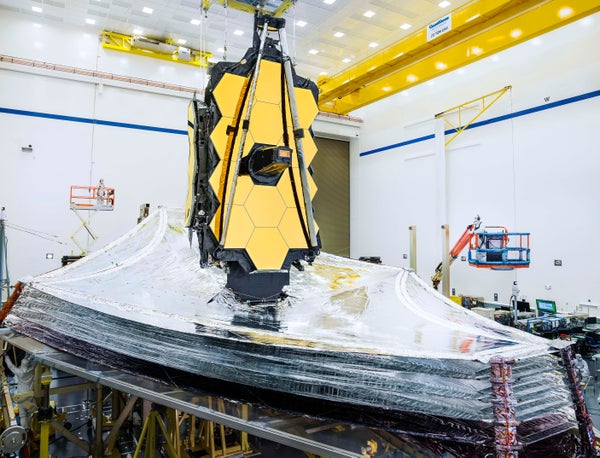
But before it can become NASA's next great observatory, Webb needs to complete a host of milestones this year. Right now, the spacecraft is being packed up from the first test of its deployment. Next, engineers will subject the spacecraft to the type of vibration and acoustic environments it will experience during launch on an Ariane 5 rocket.
Then, the mission team will test deploying it again to ensure that those environmental tests didn't create any new problems. A host of other, smaller tasks are also scheduled for this year, according to NASA's Eric Smith at a separate town hall dedicated exclusively to Webb, which is currently estimated to
cost about $9.7 billion. One vital step will be replacing some electronics that failed during an earlier test, which Smith said is the type of work that has never been done on the telescope before.
Smith emphasized both that the bulk of the work on Webb is complete and that the activities scheduled for the next 15 months are crucial to the mission's success.
"We're just about done constructing the observatory; pretty soon it's our job here to realize the promise of that," Smith said. "We have the James Webb Space Telescope now. What we have to do is make sure it works as planned."
It's not just Webb that will spend the year preparing for launch — the project's humans will as well, according to mission operations project scientist at NASA's Goddard Space Flight Center in Maryland Jane Rigby. The team conducted nine rehearsals in 2019 of various phases of the mission, from launch through
deployment and a six-month commissioning phase and into gathering science data; Webb staff will complete another 14 such rehearsals this year.
Webb isn't the only major telescope that NASA's astrophysics team is building this year; the
Wide Field Infrared Survey Telescope, or WFIRST, is also a key focus of the division's resources, Hertz said.
"We are at peak spending on WFIRST right now so we are at the point in the program where we are getting the most done every year as we make progress toward launch in the 2020s," Hertz said. At one point during his presentation, he pointed to a slide of tasks for the year. "You can read this: We're building stuff," he said.
That work is supported by the NASA budget that Congress approved last month, which fully funds both Webb and WFIRST, despite President Donald Trump administration's
proposal to cancel the latter program. The December approval of a budget marks a break from recent years characterized by drawn-out negotiations that have left agencies in the dark about the funding they would receive.
"I'm not sure how many years it's been since the last time I could stand in front of you and say, 'I have received my appropriation for the current fiscal year,'" Hertz said. "Those of us who work for the federal government are ecstatic. … It's really good news.
Copyright 2019 Space.com, a Future company. All rights reserved. This material may not be published, broadcast, rewritten or redistributed.