
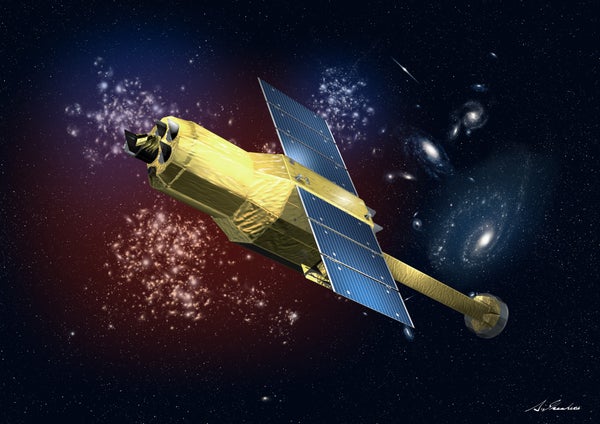
The Japan Aerospace Exploration Agency (JAXA) lost contact with its flagship X-ray astronomical satellite, Hitomi, on March 26. The observatory, launched on February 17, had been going through initial check-outs and calibrations.
Hitomi's status remains unknown as JAXA engineers work to re-establish communication. Ominously, the US Joint Space Operations Center, which tracks space debris, reported spotting five objects in the vicinity of the spacecraft around the time it went silent. The centre characterized the objects as pieces of a “break-up”.
The space debris could indicate some minor pieces blowing off Hitomi as opposed to complete destruction, says Jonathan McDowell, an astronomer and space analyst at the Harvard-Smithsonian Center for Astrophysics in Cambridge, Massachusetts.
On supporting science journalism
If you're enjoying this article, consider supporting our award-winning journalism by subscribing. By purchasing a subscription you are helping to ensure the future of impactful stories about the discoveries and ideas shaping our world today.
Hitomi, which was known before launch as ASTRO-H, is designed to study X-rays streaming from cosmic phenomena such as black holes, galaxy clusters and dark matter. It carries a high-resolution spectrometer to measure X-ray wavelengths in exquisite detail. Earlier versions of the same instrument have twice met a grim fate on JAXA missions: in 2000, the ASTRO-E telescope crashed on launch, and in 2005 a helium leak aboard the Suzaku satellite crippled its spectrometer within weeks of launch.
JAXA lost contact with Hitomi at 4:40 p.m. Japan time on March 26. “The cause of the communication failure is under investigation,” the agency said. It has, however, received at least one short signal from the satellite since then, and is working on possible ways to start talking to it again.
Agency engineers have pulled off spaceflight saves before. Most recently, JAXA placed the Akatsuki spacecraft into Venus orbit in December, five years after a failed engine burn seemed to doom the mission. And in 1993, a US X-ray mission named ALEXIS made it to orbit but was not heard from for three months. But spacecraft engineers eventually recovered it, and it went on to do its planned X-ray science.
International partners on the Hitomi project include NASA, the European Space Agency, the Netherlands Institute for Space Research, and the Canadian Space Agency.
This article is reproduced with permission and was first published on March 27, 2016.